



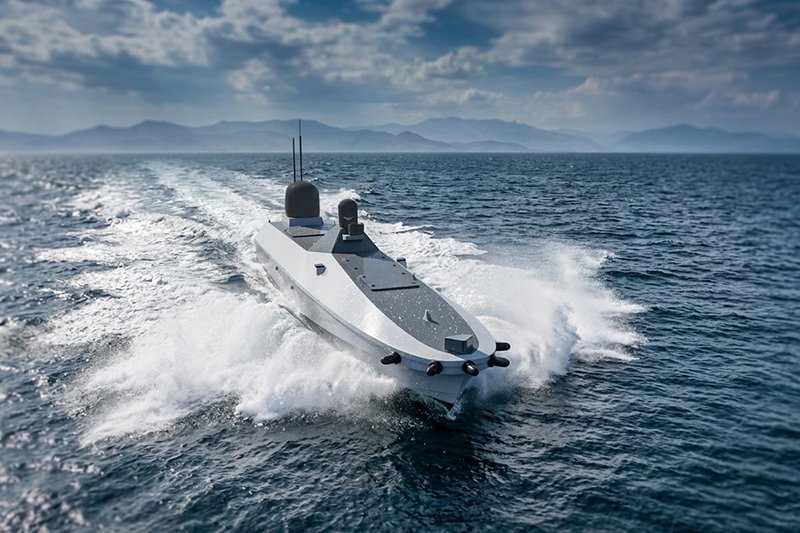
USVs: Types, Top Manufacturers and Their Role in Modern Naval Warfare
Unmanned Surface Vehicles (USVs), also known as uncrewed surface vessels, are autonomous or remotely operated maritime platforms that operate on the surface of oceans, seas, rivers, and lakes without any onboard crew. Powered by advances in artificial intelligence, autonomous navigation, satellite communications, sensors, and networking technologies, USVs have become one of the fastest-growing capabilities in modern naval warfare.
Originally developed for hydrographic surveys and scientific research, USVs have rapidly evolved into versatile military assets capable of intelligence gathering, surveillance, reconnaissance, mine countermeasures, anti-submarine warfare, electronic warfare, logistics support, force protection, and even precision strike missions. Their growing use in conflicts such as the Russia-Ukraine war and the Iran-Israel/US confrontations demonstrates how USVs are reshaping maritime warfare by offering cost-effective, persistent, and low-risk operational capabilities.
A Brief History of USVs
Unmanned surface vessels have supported military operations since as early as World War II. Rudimentary drone boats were used to collect early samples of radioactive water after each atomic bomb blast during Operation Crossroads. During the Vietnam War, a 23-foot fiberglass-hulled boat was modified and assigned to Mine Division 113 at Nha Be, operating as a remotely controlled chain-drag minesweeper. More recently, USVs have been used to tow targets or serve as target drones for live-fire exercises.
Today’s technology has taken these early USV concepts and turned them into highly capable assets featuring long endurance, low observability, agility, and high speed enabling navies to carry out a wide range of modern maritime missions.
Core Missions and Classifications
USVs are typically designed and classified around the following mission sets:
- Mine Countermeasures (MCM)
- Anti-Submarine Warfare (ASW)
- Maritime Security
- Surface Warfare (SUW)
- Special Operations Forces (SOF) Support
- Electronic Warfare (EW)
- Maritime Interdiction Operations (MIO) Support
Types of Unmanned Surface Vehicles
USVs are generally categorized by size, operational purpose, and level of autonomy.
1. Small Tactical USVs
Lightweight platforms typically ranging from 1 to 7 meters in length.
Characteristics: – Portable and rapidly deployable – Operated remotely or semi-autonomously – Well-suited for coastal waters and rivers – Low acquisition and operating costs
Primary Missions: – Harbor security – Coastal patrol – Intelligence, Surveillance, and Reconnaissance (ISR) – Explosive ordnance disposal – Special forces support
2. Medium USVs
Generally between 7 and 20 meters in length.
Characteristics: – Longer endurance – Greater payload capacity – Capable of carrying radar, sonar, electro-optical sensors, and communications equipment – Often operate in coordinated groups
Primary Missions: – Anti-submarine warfare – Mine countermeasures – Maritime patrol – Electronic warfare – Escort operations
3. Large USVs
Vessels exceeding 20 meters in length.
Characteristics: – Ocean-going capability – Long endurance – Heavy payload capacity – Ability to carry missile launchers and advanced sensor suites
4. Autonomous Swarm USVs
Fleets of multiple, interconnected unmanned vessels operating collaboratively.
Characteristics: – AI-enabled decision-making – Cooperative navigation – Distributed sensing – Difficult for adversaries to counter
Primary Missions: – Saturation attacks – Port defense – Electronic warfare – Decoy operations
Major Global USV Manufacturers
United States
L3Harris Technologies — Produces medium USVs focused on ISR, maritime security, and autonomous operations.
Leidos — Developer of the Sea Hunter, one of the world’s most advanced autonomous anti-submarine warfare USVs.
Textron Systems — Produces the Common Unmanned Surface Vehicle (CUSV) for mine warfare and ISR missions.
Saildrone — Builds wind- and solar-powered USVs capable of months-long deployments for surveillance and maritime monitoring.
United Kingdom
Atlas Elektronik UK — Produces mine countermeasure USVs such as the ARCIMS system.
BAE Systems — Develops autonomous naval technologies and integrates USVs into Royal Navy operations.
Israel
Israel Aerospace Industries — Develops autonomous maritime security systems.
Elbit Systems — Produces USVs for ISR, harbor protection, and remote weapon integration.
Rafael Advanced Defense Systems — Integrates advanced sensors and weapons systems into unmanned platforms.
Turkiye
Aselsan: Develops maritime electronics, sensors, and combat systems; recently unveiled the KILIÇ USV at the SAHA 2026 Exhibition.
ARES Shipyard and Meteksan Defense: Co-produce the ULAQ armed USV family, capable of ISR, anti-submarine warfare, and missile strikes.
Roketsan: Supplies missile systems such as CIRIT and L-UMTAS, some of which are integrated onto the MARLIN USV.
Sefine Shipyard: Produces the MARLIN USV, commissioned by the Turkish Navy in 2024.
China
China State Shipbuilding Corporation (CSSC) and Yunzhou Tech are the country’s leading USV builders.
Russia
Russia’s USV programs are led by the Kronstadt Group and the Rubin Design Bureau.
Notable USV Classes Around the World
United States
X-Class: A small (3 meters or less), non-standard class built to support SOF requirements and MIO operations. It delivers a “low-end” ISR capability for manned operations and is launched from small craft such as the 11m Rigid Hull Inflatable Boat (RHIB) or the Combat Rubber Raiding Craft (CRRC). Due to its size, the X-Class has limited endurance, payload capacity, and seakeeping ability.
Harbor Class: Based on the Navy’s standard 7m RHIB, the Harbor Class is primarily tasked with maritime security and electronic warfare, with the ability to carry ISR sensors and a mix of lethal and non-lethal armament. Secondary missions include mine countermeasures, surface warfare, SOF support, and MIO support. It offers roughly 12 hours of endurance and speeds in excess of 35 knots.
Snorkeler Class: A semi-submersible vehicle (SSV) about 7 meters long that operates with only its snorkel above the surface, providing a stable platform in high seas. It has an endurance of approximately 24 hours and a top speed of 15 knots. Primary missions include mine countermeasures (including towing payloads), anti-submarine warfare, and electronic warfare, with a secondary surface warfare role that includes torpedo deployment.
Fleet Class: A purpose-built craft compatible with the handling equipment and weight limits of the 11m RHIB. Primary missions include mine countermeasures, anti-submarine warfare, surface warfare, and electronic warfare, with secondary maritime security and SOF support roles. Endurance is 48 hours or more; speed ranges from 20-24 knots while towing mine-sweeping gear to 32-35 knots when unencumbered.
United Kingdom
MAST-13 Class: A medium-sized, highly modular USV developed by L3Harris ASV for the Royal Navy. At roughly 13 meters long, it offers over 72 hours of endurance and speeds up to 40 knots. Missions include ISR, mine countermeasures, anti-submarine warfare support, hydrographic survey, and force protection, with autonomous navigation and collision avoidance built in.
ARCIMS Class: A modular mine-warfare USV from Atlas Elektronik UK, about 11 meters long and diesel-powered for speeds exceeding 40 knots. With more than 36 hours of endurance, ARCIMS can tow multiple minesweeping payloads at safe standoff distances. Secondary roles include hydrographic survey, maritime security, and ISR.
SEA-KIT X-Class: A long-endurance autonomous vessel from SEA-KIT International, around 12 meters long, optimized for autonomous deployments lasting several weeks at cruising speeds of 6-10 knots. Missions include hydrographic surveying, seabed mapping, environmental monitoring, ISR, and offshore infrastructure inspection.
PAC24 Autonomous RHIB: An autonomous version of the Royal Navy’s standard Pacific 24 RHIB, about 7.8 meters long, capable of speeds exceeding 40 knots under autonomous or remote control. Missions include force protection, maritime patrol, reconnaissance, escort operations, and boarding support.
Israel
Protector Class: One of the world’s first operational armed USVs, built by Rafael Advanced Defense Systems. Measuring 9-11 meters, it reaches speeds over 40 knots with 24-48 hours of endurance depending on configuration. Missions include coastal patrol, force protection, harbor security, intelligence gathering, counter-terrorism, and surface warfare, using stabilized remote weapon stations, electro-optical sensors, radar, and loudspeaker systems.
Seagull Class: A multi-mission USV from Elbit Systems, about 12 meters long, capable of operating continuously for over four days at speeds up to 32 knots. Missions include anti-submarine warfare, mine countermeasures, ISR, electronic warfare, and maritime security, using sonar, lightweight torpedoes, and mine-neutralization systems.
Silver Marlin Class: A medium-sized autonomous USV from Elbit Systems built for maritime security, roughly 10.6 meters long, with over 24 hours of endurance and speeds up to 35 knots. Missions include harbor security, offshore infrastructure protection, ISR, border surveillance, and maritime patrol.
Russia
Vizir Class: A large autonomous vessel under development by the United Shipbuilding Corporation, roughly 7-10 meters long, with over 24 hours of endurance and speeds estimated at 35-45 knots. Missions include ISR, coastal patrol, electronic warfare, strike operations, and fleet reconnaissance.
Katran Class: A high-speed combat USV from the Kingisepp Machine-Building Plant, about 8-10 meters long and reportedly capable of speeds exceeding 50 knots while carrying reconnaissance or weapon payloads. Missions include surface strike, reconnaissance, harbor defense, and electronic warfare, developed partly in response to lessons from the Russia-Ukraine naval conflict.
Oduvanchik Class: An unmanned mine countermeasure vessel for the Russian Navy, roughly 6-8 meters long, optimized for autonomous mine detection and neutralization, with secondary hydrographic survey and port security roles.
China
JARI-USV Class: A multi-role combat USV from CSSC, about 15 meters long with a displacement of roughly 20 tons, capable of speeds over 42 knots and an endurance of about 500 nautical miles. Missions include surface warfare, anti-submarine warfare, air defense, ISR, and electronic warfare, with the ability to carry missiles, lightweight torpedoes, remote weapon stations, and phased-array radar.
Marine Lizard Class: An amphibious autonomous combat vehicle from Wuchang Shipbuilding Industry Group, about 12 meters long, reaching roughly 50 knots on water and 20 km/h on land via retractable tracks. Missions include amphibious assault, reconnaissance, coastal surveillance, logistics support, and special operations.
SeaFly-01 Class: A high-speed autonomous vessel from the China Aerospace Science and Industry Corporation (CASIC), about 10 meters long, with speeds exceeding 45 knots and roughly 24 hours of endurance. Missions include ISR, maritime patrol, target tracking, electronic warfare, and swarm operations, powered by AI-driven autonomous navigation.
D3000 Class: A large autonomous vessel from CSSC built for logistics and multi-mission support, about 30 meters long, designed to transport supplies over long distances with minimal human intervention as part of China’s push toward unmanned naval logistics.
Also Read this: ADVENT Enters Service with Its First NATO Navy
Military USVs Deployed in Armed Conflicts and Exported to Foreign Militaries
| USV System | Manufacturer | Exporting Country | Purchasing Country | Military / Agency | Status |
|---|---|---|---|---|---|
| Protector USV | Rafael | Israel | Singapore | Republic of Singapore Navy | Operational |
| Protector USV | Rafael | Israel | India | Indian Navy | Operational / Evaluation |
| Protector USV | Rafael | Israel | Various NATO Customers | Naval & Coast Guard Agencies | Exported in Limited Numbers |
| Seagull USV | Elbit Systems | Israel | Multiple International Customers | Navies (Undisclosed) | Exported / Demonstrations |
| Silver Marlin | Elbit Systems | Israel | International Customers | Maritime Security Agencies | Exported |
| ULAQ Armed USV | ARES Shipyard & ULAQ Global | Türkiye | Qatar | Qatar Coast Guard | First Confirmed Export; Delivered in 2026 |
| ARCIMS | Atlas Elektronik UK | United Kingdom | Belgium & Netherlands (MCM Program) | Belgian & Royal Netherlands Navies | Delivered as Part of Mine Countermeasure Capability |
| Inspector 125 | ECA Group | France | Belgium & Netherlands | Naval Mine Warfare Forces | Operational |
| Inspector 90 | ECA Group | France | France, Belgium & Other Customers | Mine Warfare Units | Exported |
The Role of USVs in Evolving Naval Warfare
USVs have become increasingly relevant in modern conflict, especially following the Russia-Ukraine war. Ukrainian USVs have struck and destroyed Russian warships worth hundreds of millions of dollars, showing the world just how effective these platforms can be. USVs are gaining a central role in naval strategy because they are inexpensive to produce, and when deployed in swarms, they are extremely difficult to intercept and defend against. They also reduce human casualties, since operators can control them from a safe distance. The Iran-Israel/US confrontation has further underscored the danger these systems pose.
Unmanned Surface Vehicles have emerged as a transformative capability in twenty-first-century naval warfare. Their versatility across intelligence gathering, mine countermeasures, anti-submarine warfare, logistics, electronic warfare, and precision strike missions allows navies to operate more effectively while reducing costs and risks to personnel. Recent conflicts have shown that relatively inexpensive USVs can challenge even major naval powers by exploiting speed, autonomy, and networked operations.
As artificial intelligence, autonomous navigation, and maritime networking technologies continue to mature, USVs will become an integral component of future naval forces. Rather than replacing traditional warships, they will increasingly operate alongside manned vessels as part of integrated, multi-domain fleets enabling more resilient, distributed, and technologically advanced maritime operations.
Written By:
Muhammad Asadullah Kahut
Catch all the latest defense news from around the world—join us on
Facebook, Twitter, YouTube, Instagram & TikTok.