



From Precision Engineering to Aerospace: An Exclusive Interview with Akbar Allana, Director Alsons Group
Alsons Group has built a strong reputation in precision engineering and manufacturing over the past seven decades. What strategic factors led to the creation of AKAL Group?
AKAL was really the next logical step for us. Over the decades, we have built a strong base in precision manufacturing, defence production, product development, and high quality engineering at scale.
At a certain point, we started to ask ourselves whether we just wanted to remain a supplier of parts and subassemblies, or did we want to move into higher-value technologies and systems? AKAL was created as a part of that transition.
For us, this was more than just a business move – it is also a national objective. Pakistan has to build its own capabilities in aerospace, UAV propulsion, autonomous systems, and advanced defence technologies. We cannot remain dependent on others forever. AKAL is our attempt to contribute seriously to that space.
How can you define your long-term vision and how does Alsons Group’s broader industrial base support and strengthen its entry into aerospace and defence technologies?
The long-term vision is to build AKAL into a credible, and standalone, Pakistani aerospace and defence technology company. We are, obviously, not starting from scratch. Alsons already has a very strong industrial base. We have supplied precision components, sub-assemblies, and munition fuzes to local and global defence OEMs such as Pakistan Ordnance Factory, Thales Group, and Junghans Defence for many years. We have also supplied advanced high-tech automotive products – such as speedometers, switches, and brake assemblies – to companies like Honda, Suzuki, and Toyota. These are all demanding customers. You cannot supply them unless your quality, reliability, and manufacturing disciplines are at a serious level.
More recently, Alsons also became the first company to indigenously design and manufacture an ICU ventilator in Pakistan. That was a major achievement for us, because it proved that Pakistani industry can develop complex, regulated, world class life-saving technology locally.
So, AKAL is not just another startup with a great idea or a prototype. We are building on real industrial credibility – both locally, and globally.
What are the key technology domains and business verticals that Alsons, particularly AKAL, intends to prioritise over the next five to ten years?
We will stay focused on areas where we believe Pakistan needs capability, and where Alsons has a real advantage.
The main priority for AKAL, currently, is UAV propulsion. That includes engines, propulsion packages, engine accessories, testing, and integration support. Beyond that, we are looking at advanced defence manufacturing, proximity fuzes, autonomous platforms, precision aerospace components, embedded systems, platform integration, and AI-enabled engineering tools.
Alsons has already been involved in defence manufacturing for decades, especially in munition fuzes, precision components, and sub-assemblies. Now we want to take that experience into more advanced areas. We aim to build depth and become genuinely competitive – not just locally, but internationally as well. This is our strategy for AKAL, as well as for our line of medical devices. We see healthcare and aerospace/defence as key strategic areas where Pakistan needs to build genuine depth and capacity – and we aim to play our part in realising this objective.
The real challenge is that aerospace and defence technologies require time, capital, infrastructure, testing, certification, and long-term commitment.
We need the state to support indigenous industry through local procurement, funding opportunities, R&D facilitation, testing infrastructure, export support, and favourable policies. This is the model followed by countries that have successfully industrialised defence production – like China, Turkey, and India, for example.
How do you see AKAL shaping the long-term roadmap for UAV propulsion, certification, and platform integration?
For us, UAV propulsion has to be treated as a complete system, and not just as a standalone engine. The engine, propeller, fuel system, mounting, vibration behaviour, electronics, telemetry, payload, endurance requirement, and operating environment all have to work together. If these are not integrated, or catered for properly, the engine alone does not solve the problem.
Our roadmap is to design and develop propulsion solutions that are reliable, practical, and easier for UAV manufacturers to integrate and support. Testing and qualification will obviously be very important. Defence customers need data, endurance testing, documentation, configuration control, and proper validation. Our aim is to build Pakistani propulsion products that can earn that confidence through engineering and performance.
What critical gap in the global UAV engine ecosystem is AKAL designed to address and how does it differentiate from established competitors?
There is a clear gap in the UAV engine market, especially for small and tactical UAVs. Many platforms are still using adapted hobby engines, expensive imported engines, or engines that are difficult to maintain and support locally. For many countries, the problem is not only price. It is availability, support, supply-chain security, and the ability to adapt the product to their needs. AKAL is designed to address that gap.
Our strength is that we are not just trading or assembling products. Alsons has real manufacturing depth. We can design, develop and manufacture precision components, control quality, develop tooling, test products, and support them over time.
Other manufacturing companies may have scale, but few have the type of vertically integrated setup, and range of engineering capabilities, we have at Alsons. Our ability to integrate various technologies into a final product means that AKAL can offer agility, cost competitiveness, and a more collaborative engineering approach. For Pakistan, this is also strategically important. UAV propulsion is an area where we should not remain dependent on foreign suppliers forever.
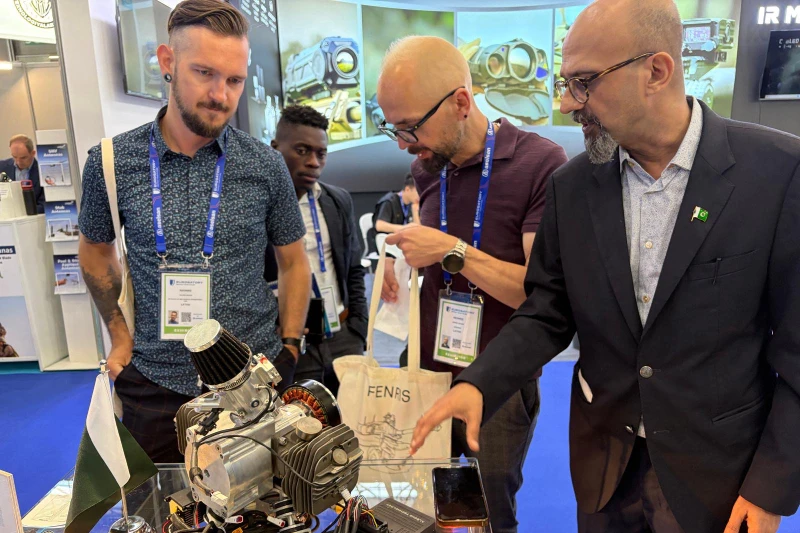
With the AKAL UAV engine debut at Eurosatory 2026, what were the key breakthroughs that enabled Alsons Group to transition into aerospace propulsion manufacturing?
The AKAL UAV engine debut at Eurosatory 2026 was a proud moment for us, and for Pakistan. The breakthrough was not one single part, or one single technology. It was the ability to bring together design, materials, precision machining and manufacturing, assembly, testing, and validation into one focused propulsion programme.
Alsons already had much of this capability. Our defence work gave us precision capabilities. Our automotive work gave us the ability to manufacture at scale. Our ventilator project gave us the confidence to design and develop complex systems locally. AKAL brought all those experiences together, and applied it to aerospace propulsion.
For us, Eurosatory was especially important because it showed that Pakistan can do more than participate in the defence market as a buyer or a part supplier. We have shown we can develop and present our own technologies on an international stage.
Global defence supply chains increasingly seek reliable partners capable of delivering integrated solutions rather than standalone components. What unique capabilities does AKAL bring to defence manufacturers and armed forces that differentiate it from traditional industrial suppliers?
AKAL is not being built as a simple parts supplier. It is being built as an engineering, development and integration partner. Through Alsons, we already have precision manufacturing, defence production experience, automotive discipline, embedded systems capabilities, quality systems, testing, tooling, and vertical integration. We have supplied global defence OEMs, major automotive companies, and we have developed Pakistan’s first locally designed and manufactured ICU ventilator. Therefore, we understand both product development and manufacturing at scale.
For defence manufacturers, AKAL can support design, development, manufacturing, integration, and lifecycle improvement. For armed forces, it means access to products that can be adapted, supported, and sustained over the long term. Our strength is that we combine a 70-year Pakistani industrial legacy with the ambition of a new aerospace and defence technology company. AKAL has been created to help Pakistan move from dependence to capability – and, eventually, from capability to global competitiveness.
Read More interviews


Catch all the latest defense news from around the world—join us on
Facebook, Twitter, YouTube, Instagram & TikTok.