


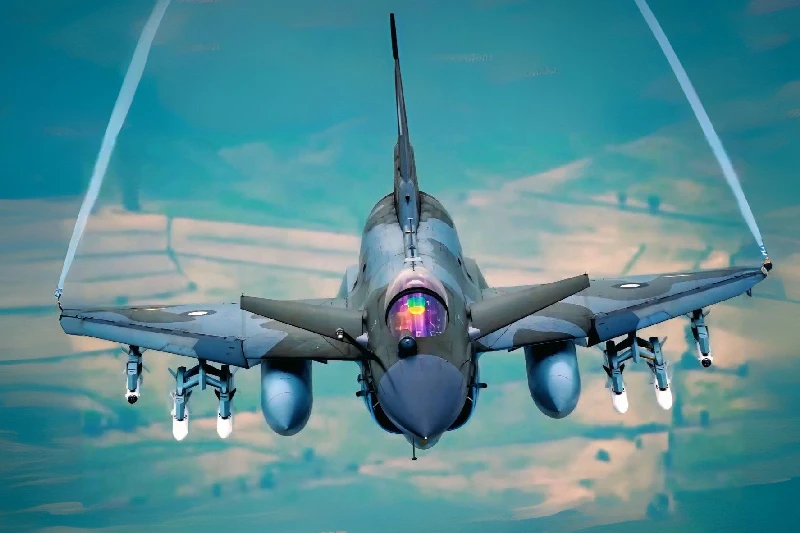
J-10CE Radar Kill: China Reveals How It Really Happened
More than a year after the largest air battle fought between two air forces in recent memory, China has quietly rewritten the story of how it happened. On the night of May 7 2025, Pakistani and Indian fighters clashed in a roughly hour-long beyond-visual-range engagement over Kashmir. Pakistan claims six Indian Air Force aircraft were shot down that night, including three Rafales, with no losses on its own side. India has never fully accepted that figure and the two countries still disagree on the details. What is independently confirmed is that one Rafale, tail number BS-001, was lost in the fight, the first combat loss of a French Rafale in history.
Official confirmation from Beijing was slow to arrive. It was not until January 2026 that the Chinese government acknowledged the J-10CE’s combat record, listing it among the country’s top ten defense science and technology stories of the year. That mattered because it meant a fighter’s real performance, until then known only from lab testing and simulation, had finally been demonstrated in actual combat.
The Old Theory: A Three-Part Formula
For most of the past year, analysts pointed to Pakistan’s advantage in airborne early warning as the deciding factor. Pakistan operates eight Swedish Saab 2000 Erieye aircraft alongside four Chinese ZDK-03 platforms, compared to India’s three EMB-145 Netra jets and three Russian-Israeli A-50EI aircraft. More coverage in the sky generally means more warning time on the ground and in the cockpit.
That advantage fed a widely accepted theory: the ZDK-03 AEW&C aircraft found the target, a J-10CE fighter fired the shot, and a PL-15 missile flew the intercept, all without the J-10CE ever switching on its own radar. Under this theory the fighter was little more than a launch platform, guided entirely by an aircraft flying safely in the background.
What Ben De Actually Said
That theory no longer holds up, according to the man who built the radar in question. In July 2026, CCTV’s program “Sister Xia’s Dialogue” interviewed Academician Ben De, one of the key figures behind China’s airborne pulse-Doppler fire control radar program and a recipient of the country’s top science and technology award. He said the J-10CE never relied on the full external targeting handoff everyone assumed. Instead, the jet’s own KLJ-7A radar and avionics carried out detection, lock-on and attack independently, out to ranges of 200 kilometers, without triggering the radar-warning or missile-approach systems on the Indian aircraft.
If accurate, this means the AEW&C aircraft were not pulling the trigger in the way most reporting assumed. The J-10CE was finding, tracking and striking its targets on its own.
A grim detail from Pakistan’s combat accounts appears to support this. Several of the downed Rafale pilots reportedly never ejected, despite modern ejection seats offering a strong survival rate. The likely reason is simple: they never received a warning at all. In air combat, the most dangerous position is not losing a fight you saw coming, it is a fight that ends before you know it started.
How the KLJ-7A Stayed Hidden
The technical explanation centers on gallium nitride, or GaN, technology. GaN allows the KLJ-7A to reduce its transmit power while keeping the same detection range, meaning less energy is broadcast for an enemy’s radar-warning receiver to pick up. The radar reportedly pairs this with frequency-hopping across a wide band, pulse compression and waveform shaping designed to make its emissions resemble background noise rather than a hostile scan.
This capability did not appear overnight. China began developing its first airborne pulse-Doppler fire control radar back in 1979, and Ben De has spent close to five decades working on that lineage. The early Type 1471 radar alone took ten years from project start to national evaluation. Ben De has said plainly that China now fields every category of radar its foreign competitors have, and in some cases does it better. He frames the shift as moving away from a pure hardware race toward software, signal processing and AI-assisted judgment as the new battleground.
Also read this: Triple Helix Model of Innovation in Military Technology and Defense Industry
The Same Radar Reportedly Beat Spectra Too
The most striking claim is what this radar allegedly got past. If Ben De’s account is accurate, the KLJ-7A did not just slip by the Russian-origin warning systems fitted to the MiG-29 and Su-30MKI. It also evaded the Spectra self-protection suite built by Thales, one of the most respected electronic warfare systems flying today and standard equipment on the Rafale.
What Comes Next
Ben De has also spoken about where radar technology is heading: beyond simply seeing a target, toward understanding it, and beyond assisting a pilot’s judgment, toward assisting the decision itself. Whether every detail of the May 7 engagement eventually holds up, that trajectory is where modern air combat is heading, and the J-10CE’s radar kill is already being presented in China as proof it works.
Catch all the latest defense news from around the world—join us on
Facebook, Twitter, YouTube, Instagram & TikTok.