



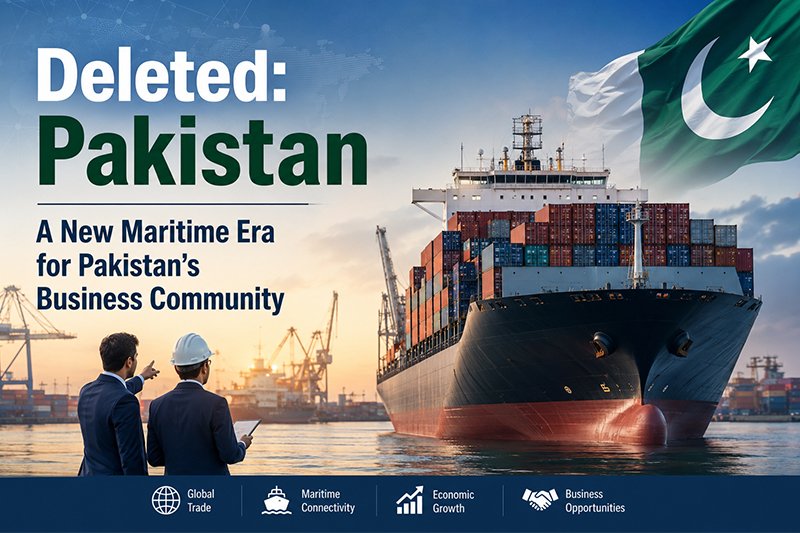
“Deleted: Pakistan”, A New Maritime Era for Pakistan’s Business Community
Pakistan’s removal from the Joint War Committee’s Listed Areas is more than a technical change in a marine-insurance circular. It is a positive reassessment of the country’s maritime-security environment and an opportunity to reduce the hidden costs imposed on Pakistani trade for nearly twenty-five years.
The Joint War Committee, comprising marine war-risk underwriters from the Lloyd’s and International Underwriting Association markets, identifies geographical areas considered exposed to enhanced risks from war, piracy, terrorism and related perils. Ships entering a listed area may be required to notify insurers, obtain additional coverage and pay extra premiums, although final rates are negotiated individually between shipowners, brokers and underwriters.
Pakistan’s experience began after the attacks of 11 September 2001 and the war in neighbouring Afghanistan. According to State Bank of Pakistan, the country was included in the War Excluded Areas list with effect from 1 October 2001. Shipping lines subsequently imposed a war-risk surcharge of $185 per twenty-foot container, along with additional charges on bulk cargo. The surcharge weakened export competitiveness, particularly for low-value products, because it was charged per container or by weight rather than according to the value of the goods.
On 29 July 2026, the Joint War Committee issued its latest Listed Areas circular, which explicitly recorded: “Deleted: Pakistan.” The decision removes Pakistan as a separately named enhanced-risk country. It does not mean that every maritime risk affecting regional shipping has disappeared, but it is an important correction to a classification that had long influenced commercial perceptions of Pakistani ports.
For Pakistan’s business community, the most immediate potential benefit is lower marine-insurance and shipping costs. Exporters, importers, charterers and shipping agents can now ask insurers and carriers to reconsider any Pakistan-specific additional premiums or war-risk surcharges. Lower voyage costs would improve the competitiveness of textiles, rice, seafood, surgical instruments, sports goods and other exports that already operate within narrow profit margins.
Import-dependent industries may also benefit. Machinery, petroleum products, chemicals, edible oil and industrial raw materials enter Pakistan largely through maritime routes. Any reduction in freight or insurance costs can lower the landed cost of production inputs, strengthen manufacturers’ margins and, where savings are passed through, provide some relief to consumers.
Delisting could also improve the commercial attractiveness of Karachi Port, Port Qasim and Gwadar. Shipping lines assess not only cargo volumes but also insurance exposure, security conditions and predictability of port calls. A more favourable risk assessment may encourage regular vessel calls, improve competition among carriers and reduce the likelihood that Pakistan-bound cargo is subjected to exceptional conditions merely because of its destination.
This matters because approximately 90 per cent of Pakistan’s trade is transported by sea. Maritime risk classifications therefore affect far more than the shipping industry; they influence exporters, manufacturers, retailers, energy supplies and the broader cost of doing business.
The decision also reflects the importance of maintaining credible maritime security. In March 2026, Pakistan Navy launched Operation Muhafiz-ul-Bahr in response to potential threats to critical sea lanes. The operation was designed to protect national shipping, preserve the uninterrupted flow of energy supplies and secure Pakistan’s Sea Lines of Communication. Escort operations were conducted in coordination with Pakistan National Shipping Corporation, while merchant-vessel movements were actively monitored to support safe transit.
Another from Author: Pakistan’s Moment at Sea: From Mediator to Maritime Architect
Operation Muhafiz-ul-Bahr demonstrated that maritime security is an economic function as much as a defence responsibility. A merchant vessel safely reaching port protects fuel availability, industrial production, export schedules and business confidence. Continued naval preparedness, port security, maritime-domain awareness and coordination with commercial operators will be essential to preserving the confidence reflected in Pakistan’s delisting.
However, expectations should remain realistic. The Joint War Committee does not determine the premium charged under an individual insurance contract. Moreover, wider waters in Persian Gulf, Gulf of Oman, Indian Ocean, Gulf of Aden and southern Red Sea remain listed within defined geographical boundaries, one of which begins from Pakistan’s coastline. Ships passing through those waters may therefore continue to face regional war-risk costs even though Pakistan itself is no longer separately listed.
The business community must now convert reputational improvement into measurable commercial relief. Ministry of Maritime Affairs, port authorities, Chambers of Commerce and exporters’ associations should engage shipping lines, insurance brokers and Protection-and-Indemnity clubs. They should seek revised quotations, transparent invoices and the withdrawal of any surcharge imposed specifically because Pakistan appeared on the risk list.
Pakistan should also communicate the decision internationally. Port-security performance, successful merchant escorts and improvements in maritime governance must be presented consistently to shipowners, insurers and investors. Delisting should be treated not as a permanent certificate, but as commercial confidence that must be protected through sustained security and regulatory performance.
For nearly a quarter of a century, Pakistani businesses carried costs linked to a security classification originating in the aftermath of 9/11. The July 2026 decision offers an opportunity to replace part of that burden with a trade advantage. Its true value will be measured not by the deletion of Pakistan’s name from a London market circular, but by lower costs, stronger exports and greater confidence in Pakistan’s maritime economy. Delisting should be treated not as a permanent certificate of safety, but as confidence that must be maintained.
Catch all the latest defense news from around the world—join us on
Facebook, Twitter, YouTube, Instagram & TikTok.

Dr. Waqas Khaliq Bhatti
Research Fellow at NIMA
Dr. Waqas Khaliq Bhatti is a Research Fellow with the National Institute of Maritime Affairs (NIMA) in Karachi. Expert in maritime strategy and regional security.