



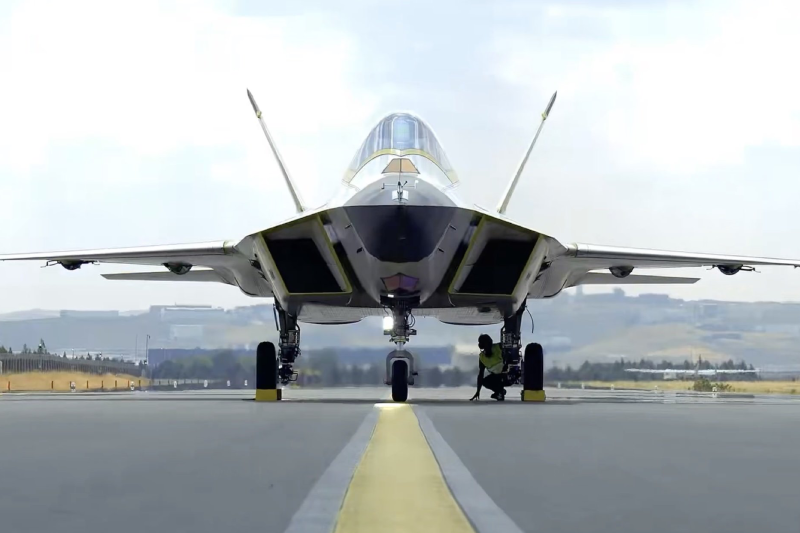
Türkiye’s Homegrown Kaan Fighter Jet Completes Pre-Flight Taxi Test
Türkiye’s domestically developed fifth-generation fighter jet has reached another milestone, with Turkish Aerospace Industries (TAI) confirming that the latest Kaan prototype has successfully completed its pre-flight taxi test.
What Happened During the Test
Footage circulating on social media showed the Kaan warplane conducting ground taxi operations under its own power, with technical personnel stationed nearby to monitor the procedure. A taxi test is a standard pre-flight checkpoint in fighter jet development, used to verify that an aircraft’s engines, braking systems, steering, and ground handling perform correctly before it is cleared for airborne testing.
TAI confirmed the test was completed successfully but did not release further technical specifics about the prototype involved or the exact date of the trial. The company has kept a steady pace of incremental disclosures throughout the Kaan program, typically confirming milestones without going into deep engineering detail.
About the Kaan Fighter Jet Program
Kaan is Türkiye’s indigenous fifth-generation multirole fighter jet, designed specifically to meet the long-term operational requirements of the Turkish Air Force. The aircraft is central to Ankara’s ambition to build an independent, domestically controlled defense-industrial base and is expected to gradually replace the country’s aging fleet of F-16 fighters over the coming decades.
The program has moved through several key phases since its public debut. Kaan made its maiden flight in February 2024, staying airborne for 13 minutes in a closely watched test that signaled the aircraft had moved beyond the design and mock-up stage into genuine flight validation. The jet followed up with a second test flight in May of the same year, during which it flew for 14 minutes, climbed to an altitude of 10,000 feet, and reached a speed of 230 knots.
Following those early flights, the Kaan program shifted into a phase focused on producing additional prototypes to expand and continue the aircraft’s flight-test campaign. Development work is now centered on the P1 and P2 prototypes, which incorporate a more advanced systems architecture than the original test aircraft, reflecting the iterative engineering approach typical of next-generation fighter programs.
Advanced Capabilities Under Development
According to TAI, the Kaan is being engineered to deliver air superiority through extended beyond-visual-range air-to-air combat capability, allowing it to detect, track, and engage targets at long distances before they come into direct visual contact. The aircraft is also designed for precision strike missions, carrying weapons internally to preserve its low-observable, stealth-oriented profile while operating at high and supersonic speeds.
A further pillar of the program is the integration of artificial intelligence and neural network technologies intended to support advanced combat performance, including faster decision-making, sensor fusion, and situational awareness for pilots operating in contested airspace. As a twin-engine platform, Kaan is being built as a true multirole fighter capable of executing both air-to-air and air-to-ground missions within a single airframe.
Timeline and What Comes Next
Türkiye has set an ambitious target of delivering the first batch of Kaan jets to the Turkish Air Force by the end of 2028. In the interim, the aircraft is expected to rely on interim engine solutions, with a fully domestically developed engine projected to become available to power the fighter sometime in the 2030s. That engine effort is widely seen as one of the more technically demanding components of the broader program, since jet engine design and manufacturing require specialized expertise that few countries possess independently.
The successful taxi test adds to a string of milestones that TAI and Turkish defense officials have pointed to as evidence the program remains on track, even as fifth-generation fighter development elsewhere in the world has often faced significant delays and cost overruns. Each ground test, flight, and prototype iteration serves as a building block toward eventual serial production and squadron integration.
Why the Kaan Program Matters
Beyond its military role, Kaan represents a strategic priority for Türkiye’s defense industry, positioning the country among a small group of nations pursuing indigenous fifth-generation fighter development. Success would reduce Turkish reliance on foreign fighter platforms and open potential export opportunities down the line, adding another dimension to the program’s significance beyond simply replacing the F-16 fleet.
As testing continues on the P1 and P2 prototypes, further flight milestones are expected in the coming months, with each step bringing the aircraft closer to its 2028 delivery target.
Catch all the latest defense news from around the world—join us on
Facebook, Twitter, YouTube, Instagram & TikTok.