



Trade, Transit and Security: The Untapped Potential of Pakistan Malaysia Maritime Cooperation
The focus of Pakistan’s strategic planning has historically remained land based, with it primarily focusing on security and economy. However, in the era of ever-increasing globalization, the importance of maritime cooperation can no longer be ignored. Southeast Asian states working together under the platform of ASEAN have emerged as global leaders of maritime cooperation and emerging economic hubs.
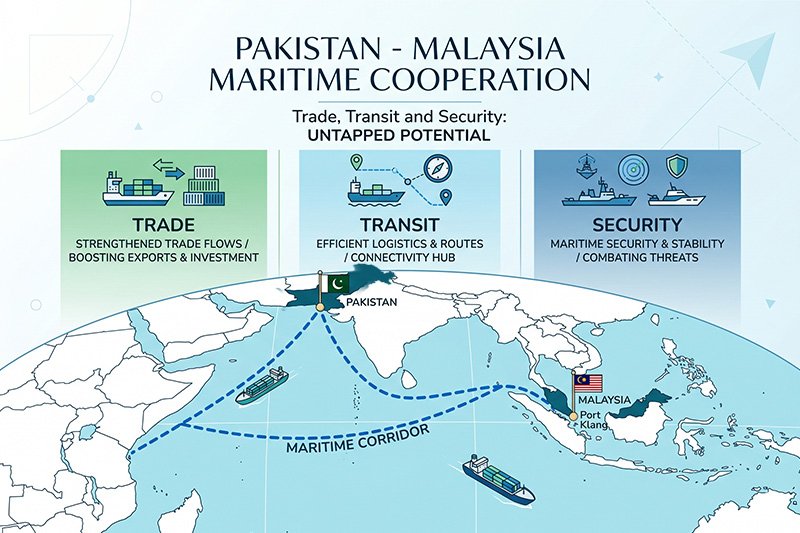
Thus, Pakistan having limited cooperation with ASEAN states can be considered as a missed opportunity. Among the ASEAN states, Malaysia and Pakistan can become a doorway to maritime strategic convergence. Pakistan must adopt a proactive regional cooperative approach that could bring enhanced dividends of such cooperation in the form of increasing trade, transit and maritime security cooperation.
Pakistan’s increased maritime cooperation with Malaysia can bring change in the volumes of trade, eventually decreasing the overall trade deficit. Pakistan’s trade with ASEAN states in the FY2024 was 11.5 billion USD, approximately equivalent to that of the EU. However, there is a great deficit where exports are around 3 billion USD and exports are 8.5 billion USD.
This imbalance is due to poor diversification and limited market competitiveness. These numbers suggest a peripheral relation of Pakistan with one of the most economically diverse regions of the world. In contrast, other states in the region have continuously increased their interaction with ASEAN states over the years. Pakistan and Malaysia have maintained friendly relations with each other based on Muslim brotherhood bond. Increasing our maritime cooperation with Malaysia would allow Pakistan to increase its access to ASEAN markets.
What makes this cooperation between Pakistan and Malaysia convenient is the strategically advantageous geographical location of both states. Pakistan is located at the crossroad of three continents, Asia, Africa, and Europe. It has proximity with the Strait of Hormuz from where around 20-25% of global energy supply passes.
Similarly Malaysia is located along the Strait of Malacca, a critical chokepoint which connects the Indian Ocean with Pacific Ocean and is responsible for approximately one-quarter of global world trade. Pakistan has been developing Gwadar port located in the Balochistan province east of the Hormuz under CPEC (China Pakistan Economic Corridor). This Chinese investment aims to connect Gwadar with Xinjiang, ultimately providing China a shorter route from the Middle East to mainland China.
While simultaneously Pakistan is exploring the possibility of connecting this route with Central Asia and to Europe as well. Pakistan can leverage this investment to create a new corridor connecting the two chokepoints. This would turn Pakistan into an economic and logistic hub.
Pakistan and Malaysia cooperation would not only yield economic dividends but would also contribute to enhanced maritime security. Pakistan’s coastline extends around 1,046 km in the Arabian Sea, protecting this naval border from different threats is as important as protecting land borders.
Read ME: The Strait of Hormuz Emerges as the New Strategic Flashpoint in Global Trade
Over the years both states have increased naval cooperation through officers training programmes, cadet exchange and joint naval exercises such as MALPAK. For Pakistan this cooperation not only provides opportunity to strengthen bilateral relations but also given the central position of Malaysia in the ASEAN, an entry point into wider ASEAN naval strategies. In the highly contested region of Indo-Pacific, this would allow Pakistan to increase maritime domain awareness, operational readiness, and maritime doctrinal development.
This relation can also contribute towards the non-traditional maritime security dimension especially when both of the states are suffering from similar issues. The waters surrounding Arabian Sea and Indian Ocean are under stress due to a number of different non-traditional maritime security challenges such as climate change, IUUF (Illegal, Unreported, and Unregularized Fishing), piracy, smuggling, and drugs and human trafficking. Pakistan’s capacity to deal with such threats remains limited as most of them are transnational issues in nature requiring a multilateral approach.
ASEAN as an organization has developed extended frameworks to deal with such issues and have seen great success. Pakistan thus can engage with ASEAN through joint exercises, information sharing and surveillance, and capacity building.
Policy formulation and successful implementation is critical for the success of this endeavor. First, Pakistan must build strong bilateral relations with Malaysia based on port development, fishing sector modernization, and maritime security. Secondly, Pakistan should try to include this bilateral relation with CPEC to create a tripod investment model.
Thirdly, Pakistan should try to cash this position to attract a relationship with the whole of ASEAN. For this plan to be successful, Pakistan must address its internal constraints. Reorientation of policy prioritization, capacity building, strong and coherent governance, and one window operation must be ensured.
In a nutshell, Pakistan can no longer modernize its economy without developing its maritime sector. Malaysia which has been a vital friendly state of Pakistan can prove to be a blessing in disguise assisting and boosting this development. If Pakistan can improve its bilateral relation with Malaysia, and multilateral relations with ASEAN as a whole it would help to increase trade, reduce trade deficit, provide access to new markets, create new corridors, improve fishing and seafood industry, and improve non-traditional maritime security.

Haseeb Ahmed Khalid
Research Assistant
The author is a fresh graduate of IR (International Relations) from NUML Islamabad. He is currently working as research assistance on a HEC research grant. His research interests include, Maritime Politics, Blue Economy, Sustainable Development, Politics of Indo-Pacific, and International Law.
Catch all the latest defense news from around the world—join us on Facebook, Twitter, YouTube, Instagram & TikTok.