


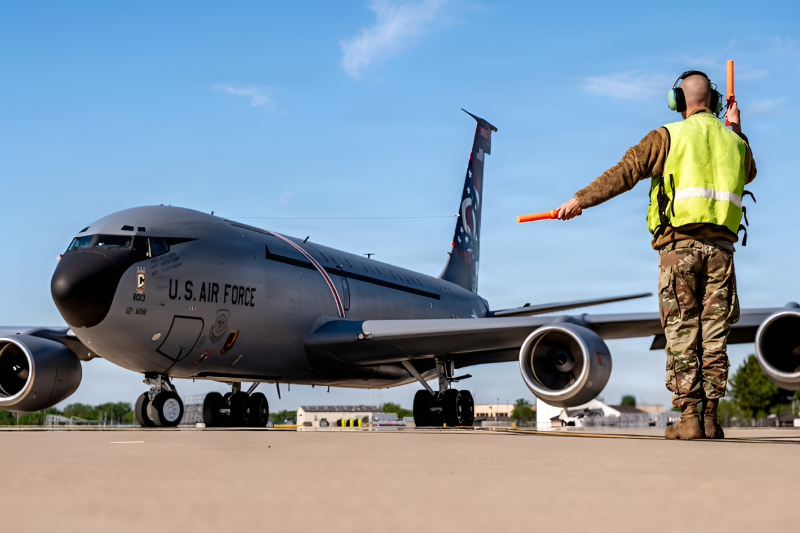
US Air Force Sets KC-135 Connectivity Deadline
The U.S. Air Force has committed to networking its entire fleet of KC-135 Stratotanker aerial refueling aircraft within six years a milestone long overdue for an aircraft that has served American air power since 1956.
The promise came from Lt. Gen. David Tabor, the Air Force’s deputy chief of staff for plans and programs, during a May 13, 2026, hearing before the House Armed Services Committee’s Seapower and Projection Forces Subcommittee. Subcommittee Chairman Rep. Trent Kelly pressed Tabor directly on the current state of connectivity aboard the KC-135 fleet. The question carried more weight than a routine budget inquiry: on March 12, 2026, two KC-135s collided over western Iraq, killing six airmen. Retired Gen. Mike Minihan, former commander of Air Mobility Command, publicly suggested the aircraft’s lack of connectivity may have been a contributing factor. Tabor’s answer was the most specific public timeline the Air Force has ever offered: “Over the course of about the next six years, you’ll see the full fleet of KC-135s fully connected.”
Why the KC-135’s Connectivity Gap Has Always Been a Problem
The Stratotanker first flew in 1956, making it older than virtually every pilot currently assigned to fly it. For nearly seven decades, it has extended the range and endurance of American fighters, bombers, and surveillance aircraft by delivering fuel mid-flight. Without the KC-135 and its successor, the KC-46A Pegasus the operational reach of U.S. air power contracts sharply. That indispensability is precisely why the Air Force has committed to keeping the KC-135 in service well past 2050.
What the aircraft has never had is the secure digital communications infrastructure that the jets it refuels carry as standard equipment. Minihan described the gap starkly in earlier congressional testimony: the receiving aircraft operate with “extreme situational awareness,” while tanker crews fly with very little awareness of the current fight. KC-135 crews cannot receive real-time threat data through secure channels and navigate congested, contested airspace using systems that predate the networks operating around them. Lt. Gen. Rebecca Sonkiss, interim commander of Air Mobility Command, summarized it simply at the 2026 Air and Space Forces Association Warfare Symposium: “Your mobility forces are not connected.”
Funding and Hardware Behind the Upgrade
Tabor’s May 13 testimony attached specific dollar figures to the solution for the first time in a public setting. The Air Force has approximately $105 million programmed for KC-135 connectivity upgrades in fiscal year 2027, with roughly $1.1 billion allocated across the Future Years Defense Program the Pentagon’s five-year investment roadmap. That funding covers 315 hybrid satellite communications terminals and approximately 240 Ku-band array kits for the KC-135 fleet, along with comparable hardware for KC-46A aircraft. A significant portion of the fleet has already received Link 16 integration, the NATO-standard tactical datalink, through the ARCTIC relay program.
The Air Force’s fiscal year 2026 budget included $124 million in KC-135 modification funding. A reconciliation bill added another $84 million specifically for connectivity work. Air Mobility Command has acknowledged both figures while noting the total need exceeds what has been appropriated so far.
ATOMS: The Software Architecture Enabling the Upgrade
The next major technological step is a system called ATOMS Airlift Tanker Open Mission System. ATOMS is a modular software architecture designed to let aging aircraft absorb new communications hardware without requiring engineers to rewrite underlying software every time a new capability is added. That flexibility is critical for a platform like the KC-135, where hardware-specific software dependencies have historically made upgrades slow and expensive. Tabor told the subcommittee that ATOMS installation across the KC-135 fleet is expected to complete within approximately four years, with hybrid satellite communications the capability that enables true beyond-line-of-sight connectivity finishing out the full six-year window.
Also read this: DATUM AŞ UNVEILS FIRST TURKISH MINI-SUBMARINE AT SAHA EXPO 2026
A Long-Overdue Reckoning for Tanker Survivability
The pace of previous investment reflects decades of decisions that treated tankers and airlifters as background support rather than survivable warfighting platforms that require the same situational awareness as the aircraft they enable. The March collision brought that calculus into painful focus. Six airmen died in friendly airspace, aboard an aircraft designed before the internet existed, without the digital tools that define modern air combat. The six-year connectivity deadline is the Air Force’s clearest acknowledgment yet that tanker crews deserve the same operational picture as everyone flying around them and that the cost of delay is no longer acceptable.
Catch all the latest defense news from around the world—join us on Facebook, Twitter, YouTube, Instagram & TikTok.