



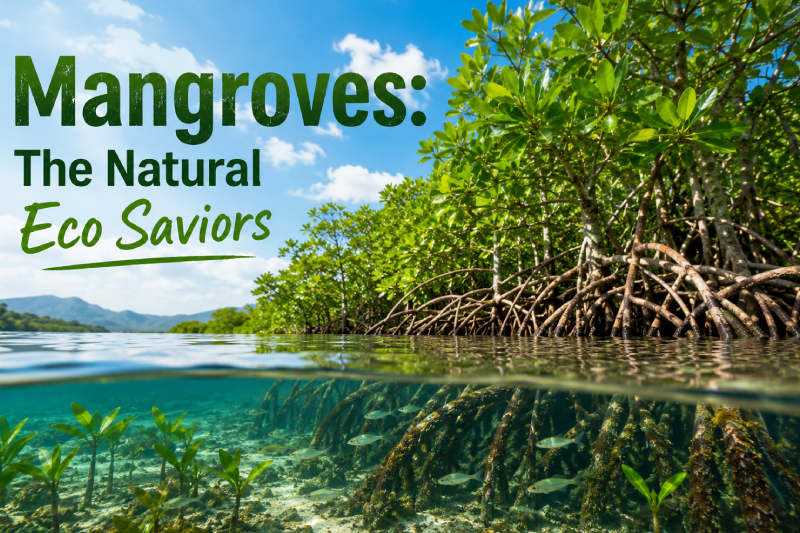
Mangroves: The Natural Eco Saviors
Mangroves are Pakistan’s natural lifelines thriving along the Indus Delta in Sindh and the Makran coast of Balochistan. They anchor shorelines, shield communities from floods and lock carbon for centuries. At the same time, they nurture fisheries and sustain thousands of coastal families whose livelihoods and food security depend on their resilience.
In 2024, International Union for Conservation of Nature (IUCN) published its first global assessment of mangrove ecosystems, the Red List of Mangrove Ecosystems. The findings are sobering: 50% of the world’s mangrove ecosystems are at risk of collapse, classified as Vulnerable, Endangered or Critically Endangered. Nearly one in five mangrove ecosystem provinces face severe risk of collapse. Sea-level rise is identified as the primary climate threat, with 25% of global mangrove area predicted to be submerged within the next 50 years. The report underscores that mangroves are not just vegetation but “natural infrastructure” vital for both humans and nature. They store 11 billion tons of carbon nearly triple the amount stored by terrestrial forests of the same size. They protect 15.4 million people and $65 billion in property annually from coastal disasters and support 126 million fishing days per year, sustaining food security and livelihoods.
Pakistan hosts one of the largest arid-zone mangrove forests in the world, concentrated in the Indus Delta. Sindh has taken mangrove growth as an important concern, with large-scale afforestation programs making it a global leader in mangrove restoration. According to official figures, Sindh has successfully expanded mangrove cover to over 200,000 hectares, reversing decades of decline. By contrast, Balochistan despite its 734.5 km coastline has not yet prioritized mangrove growth to the same extent. The Makran coast, including areas near Gwadar, Pasni and Ormara holds significant potential for mangrove expansion. Strengthening mangrove ecosystems here would not only protect coastal communities but also enhance the sustainability of fisheries and port development.
Mangroves are natural eco Saviors. In Pakistan’s deltaic regions, they limit seawater intrusion, protecting farmland from salinity. Equally vital is their role as carbon sinks: per hectare, mangroves store more carbon than many terrestrial forests, locking it in waterlogged soils for centuries. One of the most significant ecological functions of mangroves is their capacity to act as powerful carbon sinks. Mangroves store carbon mainly in their soils, which are waterlogged and low in oxygen, slowing decomposition and trapping carbon. Hence, organic carbon remains trapped for centuries. However, when mangrove forests are cleared or degraded the stored carbon is released back into the atmosphere exacerbating climate change. The IUCN assessment warns that climate change itself now accounts for 33% of global mangrove threats, including more frequent and severe storms compounding the risks of deforestation and pollution.
Also read this: MAY 2025: WHEN DETERRENCE SPOKE AND ILLUSIONS FELL
Mangrove conservation should be embedded within national climate strategies, particularly through blue carbon initiatives that can unlock climate finance. Restoration programs must prioritize native species and the rehabilitation of natural hydrological regimes. Plantation should be regularized through structured provincial and national programs, ensuring continuity rather than sporadic campaigns. In Balochistan, specific areas such as Gwadar Bay, Pasni, Ormara, and Miani Hor should be identified and developed as priority zones for mangrove plantation. Local communities must be central to conservation efforts, supported by awareness campaigns and environmental education to strengthen long-term stewardship.
Mangroves are far more than coastal vegetation; they are nature-based climate solutions, natural coastal defense systems and pillars of marine biodiversity i.e. the natural eco saviors. Their conservation is not an environmental luxury but a strategic national imperative. By safeguarding and restoring mangrove ecosystems, countries like Pakistan can enhance climate resilience, protect coastal populations and secure sustainable development for future generations.

Dr. Mushaiyada Mairaj
Research Fellow
Dr. Mushaiyada Mairaj serves as a Research Fellow at the National Institute of Maritime Affairs (NIMA), Karachi.
Catch all the latest defense news from around the world—join us on Facebook, Twitter, YouTube, Instagram & TikTok.
Discover more from International Defence Analysis
Subscribe to get the latest posts sent to your email.