



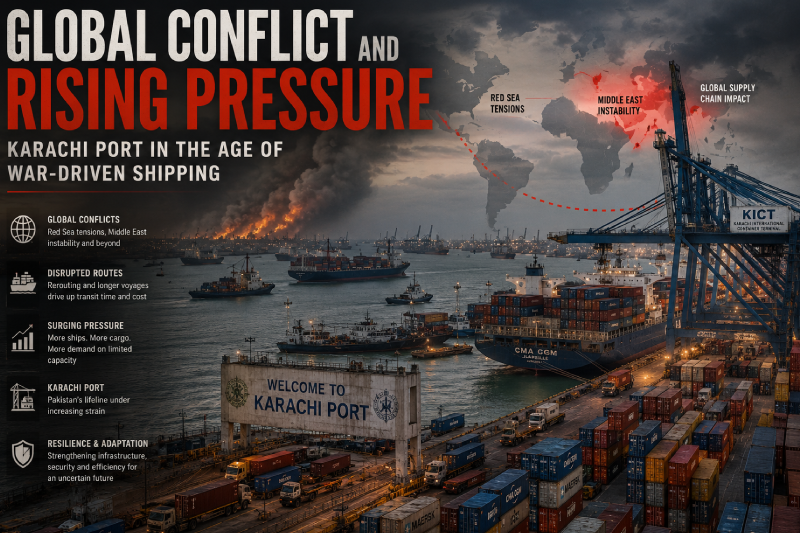
Global Conflict and Rising Pressure: Karachi Port in the Age of War-Driven Shipping
In an increasingly volatile geopolitical landscape, global maritime trade is being reshaped not by markets, but by missiles. From the war in Ukraine to escalating tensions in the Middle East, particularly disruptions in the Red Sea and the closure of the Strait of Hormuz, shipping routes are undergoing one of the most dramatic realignments in modern history. As traditional maritime corridors become conflict zones, ports outside these chokepoints are witnessing an unexpected surge. Among them, Karachi Port has emerged as a critical and unintended beneficiary of war-driven trade rerouting.
The scale of disruption is unprecedented. Since late 2023, attacks on commercial vessels in the Red Sea have forced major shipping lines to abandon the Suez Canal route, which historically carried nearly 12–15% of global trade. Traffic through the canal dropped by nearly 75% as vessels rerouted around the Cape of Good Hope, adding 10–14 days and approximately 4,500 nautical miles to voyages. This diversion has significantly increased fuel consumption up to 33% per voyage and driven freight rates upward, reflecting the economic cost of insecurity at sea (UNCTAD, 2024). As a result, global shipping companies such as Maersk and CMA CGM have been forced to rapidly redesign their logistics networks, seeking alternative hubs that are both geographically viable and politically stable.
It is within this context that Karachi Port has gained renewed strategic importance. Recent data reveals a dramatic surge in activity. In the entire year of 2025, Karachi handled approximately 8,300 TEUs (twenty-foot equivalent units) of transshipment cargo. However, in just the first 24 days of March 2026, the port processed around 8,860 containers, surpassing its previous annual volume in less than a month (Dredge Wire, 2026). This extraordinary increase illustrates how quickly global trade flows can shift when traditional routes become insecure.
This surge is not accidental. Karachi’s geographic position just outside the immediate conflict zones of the Gulf while still proximate to major shipping lanes makes it an attractive alternative. New feeder services connecting Karachi to regional hubs such as Fujairah and Khor Fakkan further indicate a structural shift in trade logistics.
However, while this presents a major opportunity, it also exposes structural weaknesses. The sudden influx of cargo has led to congestion, container backlogs, and increased vessel waiting times. Infrastructure designed for steady growth is now under pressure from exponential demand. Without rapid modernization particularly in port automation, digital tracking systems, and hinterland connectivity Karachi risks turning opportunity into inefficiency.
To manage the current surge effectively and convert it into long-term advantage, Karachi Port Trust (KPT) must adopt a proactive transformation strategy.To secure long-term cargo growth, Karachi Port must focus on several key reforms at the same time. First, rapid infrastructure modernization is essential, including expanding terminals, deepening berths for larger vessels and upgrading cargo-handling equipment to prevent congestion. Alongside this, port operations must be digitalized through real-time cargo tracking, a fully integrated Port Community System (PCS) and block chain-based documentation to reduce delays and improve efficiency.
In addition, Karachi needs competitive tariff and incentive structures, such as lower transshipment rates, long-term contracts and performance-based incentives to attract and retain major shipping lines like Maersk and CMA CGM. Stronger hinterland connectivity is also necessary, with improved road and rail links to industrial zones and better integration into CPEC corridors to ensure smooth cargo movement.
At the same time, maritime security and operational reliability must be strengthened to maintain confidence in Karachi as a safe and stable alternative to regional ports. KPT should also develop long-term strategic partnerships with global shipping companies through joint ventures, dedicated terminals and long-term agreements that convert temporary rerouting into permanent trade flows. Finally, policy stability and simplified procedures such as faster customs clearance and a one-window system are essential to ensure predictability and make Karachi a more competitive global logistics hub.
Dont miss this: Mangroves: The Natural Eco Saviors
Now that traditional shipping routes have reopened, a significant portion of the diverted traffic is likely to move back to the established corridors. However, continued or renewed instability in the future could again increase the strategic importance of alternative ports like Karachi. The key question, therefore, is whether Pakistan can turn this temporary surge into lasting gains through timely reforms, infrastructure development, and sustained investment.
Karachi Port stands at a critical inflection point. What appears today as a windfall driven by geopolitical disruption can either fade with the return of stability or evolve into a lasting transformation of Pakistan’s role in global trade Securing this influx as permanent cargo requires deliberate action modernizing infrastructure, digitizing operations, ensuring policy consistency and building long-term partnerships with global shipping lines. In an era where maritime routes are shaped as much by conflict as by commerce, Karachi’s success will depend not on its location alone, but on its ability to convert crisis-driven relevance into enduring competitiveness.
Reference:
UNCTAD. (2024). Review of maritime transport 2024. United Nations Conference on Trade and Development. https://unctad.org
Dredge Wire. (2026). Hormuz crisis: Pakistan transforms Karachi Port into one of the world’s largest deep-sea ports. https://dredgewire.com

Dr. Mushaiyada Mairaj
Research Fellow
Dr. Mushaiyada Mairaj serves as a Research Fellow at the National Institute of Maritime Affairs (NIMA), Karachi.
Catch all the latest defense news from around the world—join us on Facebook, Twitter, YouTube, Instagram & TikTok.