



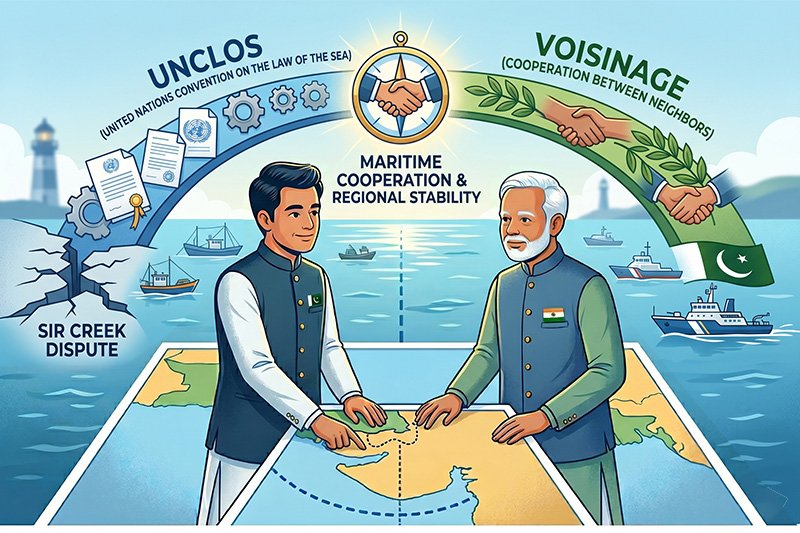
Beyond Sir Creek Dispute: UNCLOS and Voisinage as Pathways to India–Pakistan Maritime Cooperation
Abstract: This article proposes the “Sir Creek Dialogue: Fostering Voisinage and Cooperation,” an initiative, as a pragmatic pathway for India and Pakistan to manage the complex Sir Creek maritime boundary dispute. Grounded in the principle of voisinage (good neighborliness), this approach aims to move beyond entrenched geopolitical positions, build mutual confidence, and ensure a stable and prosperous future for communities reliant on this vital estuary.
The famous Sir Creek, forms part of the boundary between Pakistan’s Sindh province and India’s Gujarat state. The Creek acted once as a natural boundary marker in colonial revenue administration. The Sir Creek dispute had erupted between Kutch and Sindh in 1908, what was then known as ‘Ban Ganga’.The Sir Creek basically is a 96-kilometre-long tidal estuary located in the Rann of Kutch.
The dispute lies in differing interpretations of colonial era administrative instruments. The most significant is the Resolution 1192 of the Government of Bombay, 1914. The Sir Creek disagreement is essentially over whether the border between Sindh and Gujarat is within the estuary or on the eastern bank of the estuary. If the border is within the estuary itself, then both India and Pakistan will have ownership of the waters of the Sir Creek. If the border is determined to be the eastern bank of the Sir Creek estuary, then Pakistan has full ownership of the creek and India does not have access to the waters.
The dispute persisted through multiple rounds of bilateral talks, including those in the 1960s and 2000s. A near-resolution in 2007 and 2012 faltered due to domestic political pressures. The issue extends beyond land to maritime delimitation, influencing exclusive economic zones (EEZs) and continental shelf claims under UNCLOS Articles 74 and 83. For Pakistan Sir Creek is very important, in the north-eastern Arabian Sea the dispute affects thousands of square kilometers (approximately 8,000 sq.km) of potential maritime entitlement.
This uncertainty constrains not only offshore hydrocarbon exploration and fisheries management. It is also affecting maritime law enforcement, and effective implementation of the national and international laws.
Read ME: Trade, Transit and Security: The Untapped Potential of Pakistan Malaysia Maritime Cooperation
The solution to the Sir Creek Dispute lies in the Dialogue fostering “Voisinage and Cooperation”. The idea is centered on establishing a “Special Arbitral Tribunal” under UNCLOS Part XV, Annex VIII, offering India and Pakistan a credible and pragmatic avenue for resolving the Sir Creek maritime boundary dispute. This proactive approach aligns with Pakistan’s foreign policy objectives of regional stability and economic development, while simultaneously serving as a significant confidence building measure with India. A successful resolution would not only address a critical bilateral issue but also serve as a model for constructive engagement in other contentious areas across South Asia, contributing to lasting peace and cooperation in the region.
Both India and Pakistan are States Parties to UNCLOS, obligating them to settle disputes concerning the interpretation or application of the Convention through peaceful means is important. UNCLOS Part XV, Section 1, Article 279, mandates such peaceful settlement, while Section 2, Article 286, provides for compulsory procedures entailing binding decisions if other peaceful means fail. Article 287 outlines several choices of procedures, including recourse to a Special Arbitral Tribunal constituted in accordance with Annex VIII.
Given the intricate nature of the Sir Creek dispute, which involves complex maritime delimitation and hydrographic considerations, a Special Arbitral Tribunal under Annex VIII is particularly well-suited for settlement of this dispute. Annex VIII tribunals are designed for specific categories of disputes, such as those concerning fisheries, the protection and preservation of the marine environment, marine scientific research, or navigation, including pollution from vessels and by dumping.
The Sir Creek region inherently encompasses aspects related to maritime delimitation, navigational rights, and environmental protection, such as the impacts of pollution on the Indus River outflow into the Arabian Sea. These elements align directly with the categories addressed by Annex VIII, ensuring a specialized and informed adjudication. This framework would begin with Pakistan formally notifying India of its intent to seek a settlement under UNCLOS Part XV and inviting bilateral negotiations for the delimitation of the Sir Creek boundary, in line with UNCLOS Article 283 which emphasizes the exchange of views.
If direct negotiations do not yield a comprehensive settlement, the proposal would then move towards establishing a Special Arbitral Tribunal. This tribunal would typically consist of five members: each party appointing two members, preferably from a list of experts maintained by the UN Secretary-General, and a fifth member serving as president, jointly appointed by both parties.
If the fifth member is not appointed within 60 days, the UN Secretary-General would make the necessary appointment at the request of either party. The Tribunal’s jurisdiction would be strictly limited to the interpretation and application of UNCLOS concerning the maritime boundary delimitation in Sir Creek, considering relevant geographical, historical, and environmental factors, including the unique sound speed profiles and sediment characteristics of the northern Arabian Sea. It’s decisions would be binding and without appeal, applying UNCLOS and other compatible international laws
Utilizing an Annex VIII Special Arbitral Tribunal offers several strategic advantages for both nations. The specialized nature of these tribunals ensures that highly qualified experts in hydrography, maritime law, and environmental science are integral to the resolution process. This technical proficiency is critical for a nuanced understanding and equitable resolution of the Sir Creek boundary.
By referring the dispute to a legal body under a multilateral treaty, the process can effectively depoliticize the issue, allowing for a focus on the legal and technical merits rather than political rhetoric or bilateral tensions.
A successful resolution of the Sir Creek dispute could establish a powerful precedent for constructive engagement across South Asia, addressing other areas of contention, including transboundary environmental issues. This demonstrates a commitment to peaceful dispute resolution under international law.
Pakistan’s proactive engagement with UNCLOS mechanisms would reinforce its commitment to international law and responsible state behavior, potentially attracting international partners for future maritime cooperative ventures. Pakistan’s growing role in maritime security and the blue economy is of increasing international interest. A clearly defined boundary would provide the necessary clarity for the sustainable management of marine resources, fisheries, and environmental protection initiatives in the Sir Creek region. This would enable both nations to jointly tackle shared challenges such as pesticide contamination in the Indus River outflow.
.jpg)
Attorney Muslim Bin Aqeel Khan
International Maritime Lawyer
Attorney Muslim Bin Aqeel Khan is an International Maritime Lawyer and defense analyst. He has served as a Maritime Consultant to various international law firms dealing Maritime industry. As CEO of the Research Center for International Maritime Law & Practice, he specializes in admiralty law, maritime security, and international trade. He currently leads legal consultancy for the region’s first international ferry service connecting Pakistan to the Gulf.
References & Sources
-
. “The Sir Creek story of a chance missed”, Oct 08, 2025.
https://www.tribuneindia.com/news/comment/the-sir-creek-story-of-a-chance-missed/ -
, RSIL. “Sir Creek, Climate Change and Stability in South Asia”, n.d.
https://rsilpak.org/2022/sir-creek-climate-change-and-stability-in-south-asia/ -
. “Sir Creek and its Legal and Political Significance and Resolution”. DOI: 10.53963/pjmr.2019.005.1.
View PDF Document - Ibid.
-
. “Pak Army fires back at Indian threats”, Pakistan Today, 02-11-2025.
https://www.pakistantoday.com.pk/2025/11/02/pak-army-fires-back-at-indian-threats/ - (2024). “Water Dispute between India and Pakistan: An Analysis”.
- (2024). “Analyzing the impact of pesticides on the indus river: contamination levels in water, sediment, fish, and associated human health risks”.
- (2024). “Acoustic Propagation and Transmission Loss Analysis in Shallow Water of Northern Arabian Sea”, JMSE, Vol. 12, Pages 2256.
- (2024). “Maritime Security & Counter-piracy: Way Forward for Pakistan under International Law”. DOI: 10.62843/jrsr/2024.3a022.
- (2024). “Analyzing the impact of pesticides on the indus river: contamination levels in water, sediment, fish, and associated human health risks”.