



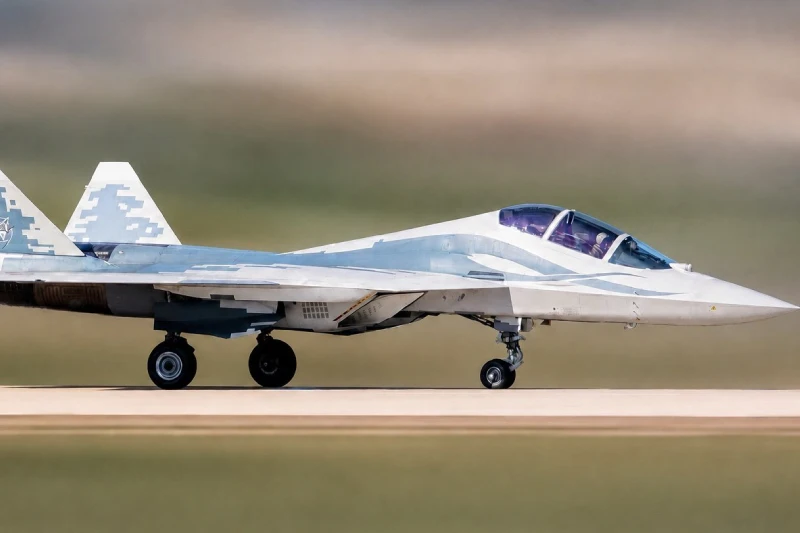
Russia Unveils Twin-Seat 5th Gen Fighter for Drone Warfare
Russia has officially pulled back the curtain on a twin-seat variant of its Su-57 fifth-generation stealth fighter a development that marks a significant turning point not just for the aircraft’s program, but for modern air combat as a whole. Photographs showing the new configuration conducting ground taxi trials have surfaced, though its official designation is still unclear. What is clear, however, is that this moment has been years in the making and carries enormous implications for global defense markets.
Until now, the Chinese J-20 stood alone as the only fifth-generation fighter in the world to have a twin-seat variant in active development. The United States once flirted with a two-seat version of the F-22 Raptor, and the Soviet Union had similarly advanced plans for the MiG 1.42 and its twin-seat counterpart. Both efforts were ultimately shelved victims of post-Cold War budget cuts and shifting defense priorities. Russia’s decision to push forward where others retreated places the Su-57 in rare company.
There was a time when the military aviation world seemed to be moving away from two-seat fighters entirely. Advances in avionics, automation, and single-pilot workload management made the second crew member seem redundant. That logic is being revisited now, and drone warfare is the reason why.
As fifth-generation fighters are increasingly expected to act as airborne command hubs directing swarms of unmanned “loyal wingman” drones during complex combat missions the cognitive load on a lone pilot becomes a serious operational concern. A second crew member dedicated to managing drone coordination, electronic warfare, or sensor fusion changes the equation entirely. The twin-seat Su-57 isn’t just a training variant; it’s a direct response to where the battlefield is heading.
Russian officials have been signaling this development for years. Back in June 2021, Deputy Prime Minister Yuri Borisov publicly confirmed that a twin-seat Su-57 was being developed specifically to meet foreign demand. He noted that international clients tend to watch how Russia’s own armed forces use a weapon system before committing and that a two-pilot configuration would both attract new buyers and deepen existing interest.
Months earlier, in December 2020, Andrey Yelchaninov of the Russian Military-Industrial Commission confirmed that at least one potential export client had already expressed specific interest in a twin-seat version. He added that Russia’s own Defence Ministry was actively considering acquiring the variant as well. Negotiations at the time covered everything from delivery options to weapons packages to after-sales service suggesting these talks were serious and progressing well.
When Yelchaninov mentioned an unnamed foreign client inquiring about a twin-seat variant, defense analysts widely interpreted that as a reference to India. New Delhi has a well-documented history of favoring twin-seat fighter configurations for its air force a preference shaped in large part by the massive orders it placed for the Su-30MKI over the years. India’s influence on the development of advanced Russian combat aircraft is not new territory.
In January of this year, India’s Defence Ministry confirmed that license-production talks for the Su-57 had reached an advanced technical stage, following an initial confirmation the prior year that negotiations were underway. The proximity of that announcement to other Su-57 export news strongly suggests that Indian requirements possibly including the twin-seat configuration are playing an active role in shaping how the program evolves.
Also read this: US Air Force Sets KC-135 Connectivity Deadline
Russia’s state defense export agency, Rosoboronexport, confirmed in April that multiple countries had placed firm orders for the Su-57. That announcement was preceded by a February statement from Industry and Trade Minister Anton Alikhanov, who revealed that contracts had already been signed in the Middle East with Iran widely regarded as the most probable buyer in that region.
The convergence of these events paints a picture of an export program that has moved well beyond the speculation phase. Real contracts are in place, and real customers are shaping what the aircraft becomes.
It’s a question worth taking seriously. The Su-27’s twin-seat derivative, the Su-27UB, became the foundation for the Su-30MKK and Su-30MKI aircraft that were ultimately produced in far greater numbers than the original single-seat Su-27 or its upgraded Su-35 successor. If Indian and Iranian procurement leans heavily toward twin-seat Su-57s, other potential buyers like Vietnam could follow the same path.
The twin-seat Su-57 is no longer just a rumor or a design exercise. It’s a taxiing aircraft with real orders behind it and a very real role to play in the future of air combat.
Catch all the latest defense news from around the world—join us on Facebook, Twitter, YouTube, Instagram & TikTok.