



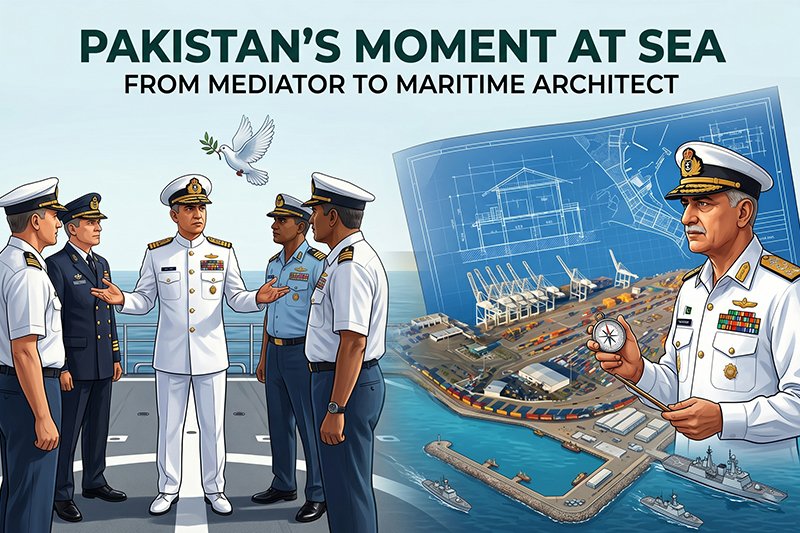
Pakistan’s Moment at Sea: From Mediator to Maritime Architect
There are rare moments in international politics when a state does more than merely protect its interests; it helps prevent a wider catastrophe. Pakistan’s recent role in efforts to stop the war between United States and Iran appears to be one of those moments. By helping keep channels open between hostile parties, hosting talks in Islamabad and sustaining diplomatic contact even when negotiations faltered, Pakistan did not simply perform routine diplomacy.
It acted as a stabilizer at a moment when West Asia stood dangerously close to a strategic rupture with global consequences. Pakistan’s own official messaging has stressed that it “consistently worked, in good faith, for de-escalation,” while its leadership publicly affirmed a continued resolve to build momentum for meaningful results in the interest of regional and global peace.
The significance of that effort becomes even clearer when placed beside the reopening of Strait of Hormuz. On April 17, Iran announced that the strait was open again to commercial shipping, a move that immediately eased pressure on global energy markets and shifted the narrative from blockade, brinkmanship and war-risk premiums toward de-escalation and transit security. Oil prices fell sharply after the reopening announcement, underscoring a simple truth: maritime chokepoints are not abstract lines on a map; they are arteries of the world economy.
That is precisely why Pakistan’s role matters beyond the headlines. A country that helps cool a war affecting Strait of Hormuz is not just acting in diplomatic self-interest. It is shaping the security of sea lanes, energy flows and regional order. In other words, Pakistan has shown that it can no longer be described only through the tired vocabulary of crisis management, aid dependence, or continental security anxieties. It has demonstrated that it can function as a serious regional player in the maritime domain.
This matters because Pakistan’s geography has finally caught up with its diplomacy. For too long, the country’s maritime identity remained underused in policy imagination. Pakistan was treated as a state that looked inland first and seaward second. Yet its location; linking South Asia, Arabian Sea, Gulf and western Indian Ocean, gives it a unique strategic advantage. Any serious effort to stabilize trade routes, secure energy corridors, and institutionalize regional dialogue across this maritime space will eventually have to pass through Pakistan, or at least be shaped by it.
Read Me: Completing the Maritime Picture: Why Regional Information Hubs Matter in the Strait of Hormuz Crisis
The recent mediation effort proves that Islamabad can do more than host meetings. Pakistan was involved in backchannel diplomacy, helped sustain contact between Washington and Tehran and offered frameworks aimed at both ceasefire maintenance and the reopening of Hormuz. Even when direct talks struggled, Pakistan remained part of the diplomatic architecture rather than an observer on the margins. International coverage has described Pakistan as central to the ceasefire effort and portrayed Pakistani leadership as key intermediaries in a highly volatile environment.
That record should now be converted into strategy. Pakistan should not treat this episode as a one-off diplomatic success to be celebrated and forgotten. It should treat it as the foundation for a new maritime political project: a regional maritime bloc, led intellectually and diplomatically by Pakistan, designed to secure sea lanes, energy transit, port connectivity, crisis communication and non-traditional maritime security across the North Arabian Sea and its adjoining waters. The case for such a bloc is strong.
First, the existing regional order is too fragmented for the scale of today’s threats. The old assumption that trade will move freely so long as navies patrol the sea is no longer sufficient. Today’s maritime insecurity includes missile threats, mining risks, sanctions-related disruption, drone warfare, cyber threats to ports, insurance shocks, and political coercion through chokepoints. The Strait of Hormuz crisis reminded the world that one escalation can raise freight costs, rattle energy markets, and expose the vulnerability of states far beyond the conflict zone. What the region needs is not another ceremonial forum, but a practical coalition focused on maritime resilience.
Second, Pakistan has the credibility to convene such a platform precisely because it has just shown it can talk to difficult capitals. A maritime bloc cannot be built by a state seen as belonging wholly to one camp. It requires a country that can maintain working relations across rivalries. Pakistan, despite its many domestic constraints, retains channels with Gulf states, Iran, China, United States and other regional actors. That diplomatic flexibility is not a weakness; it is the very prerequisite of maritime coalition-building.
Third, Pakistan has a concrete material stake in maritime order. Its ports, shipping routes, energy imports, blue economy prospects, and coastal security all depend on stability at sea. A Pakistan-led bloc would therefore not be a vanity project. It would be rooted in national necessity. The disruption of Hormuz is not someone else’s problem for Pakistan. It affects fuel security, inflation, shipping costs, industrial planning, and strategic vulnerability at home. That gives Pakistan both urgency and legitimacy.
Fourth, this is the right moment to move from reactive diplomacy to agenda-setting diplomacy. Pakistan should propose a compact centered on five pillars: freedom and safety of commercial navigation; maritime crisis deconfliction among regional states; coordinated action on piracy, sabotage, and hybrid threats; port and logistics connectivity; and legal-political dialogue on responsible conduct in adjacent seas. Such a bloc would not need to begin as a treaty organization. It could start as a ministerial and naval consultative framework with technical working groups, coast guard cooperation, information sharing through information coordination centers and emergency communication protocols.
Importantly, this initiative should not be framed as anti-anyone. Its strength would lie in being stabilizing rather than exclusionary. A Pakistan-led maritime bloc should be presented as a platform for risk reduction, economic continuity, and cooperative security. That would make it attractive not only to littoral states but also to trading partners that depend on uninterrupted energy flows.
Critics will say Pakistan is overreaching. They will argue that a country facing economic and governance challenges should avoid grand strategy. But this objection mistakes leadership for extravagance. Regional leadership does not always begin with wealth; often it begins with relevance. And relevance is exactly what Pakistan has earned. When Islamabad becomes a venue for high-stakes diplomacy and when the reopening of the world’s most sensitive energy chokepoint follows a process in which Pakistan is deeply involved, that is not symbolism. It is geopolitical capital.
Others will argue that maritime blocs often fail because regional rivalries are too deep. That is true only when institutions are designed around idealism rather than shared interests. Here, the shared interest is obvious: no coastal or trading state benefits from a permanently militarized Hormuz environment, unstable shipping corridors, or periodic energy panic. Even competitors can cooperate where mutual vulnerability is high.
Pakistan should therefore seize this moment with confidence. It should call a regional maritime dialogue in Karachi or Islamabad. It should invite foreign ministers, naval chiefs, port authorities, energy planners, and maritime law experts. It should present a draft framework for commercial transit security and crisis coordination. It should make the case that stability at sea is no longer a secondary issue but the central question of regional peace.
The true measure of diplomacy is not applause after mediation; it is whether mediation is converted into durable architecture. Pakistan has already shown that it can help prevent escalation between adversaries. The reopening of the Strait of Hormuz has strengthened the argument that its diplomacy can produce consequences felt across the region and beyond.
Now Pakistan must think bigger. It should not remain merely the messenger in other people’s crises. It should become the architect of a new maritime order in its neighborhood. That would not only acknowledge the role it has already played; it would define the role it ought to play next.

Dr. Waqas Khaliq Bhatti
Research Fellow at NIMA
Dr. Waqas Khaliq Bhatti is a Research Fellow with the National Institute of Maritime Affairs (NIMA) in Karachi. Expert in maritime strategy and regional security.
Catch all the latest defense news from around the world—join us on Facebook, Twitter, YouTube, Instagram & TikTok.