



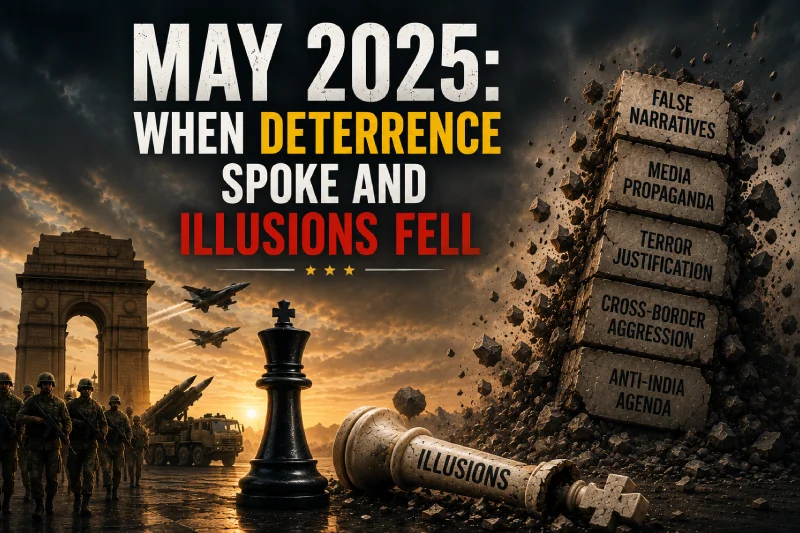
MAY 2025:Operation Bunyan-un-Marsoos
One year after Pakistan’s historic political-military triumph over India in May 2025, Operation Bunyan-un-Marsoos is considered both a military success and a pivotal moment in strategic narrative of South Asia. That was the day that India’s coercive arrogance encountered Pakistan’s disciplined resolve. It was the day that propaganda was defeated by professionalism; and the day Pakistan proved that credibility in a military structure, political sanity and diplomatic maturity remain the foundation stones for national power.
Pakistan’s Strategic Response and Military Preparedness
Pakistan’s success was not a coincidence; it was the result of superior planning and Operation Bunyan-un-Marsoos, professionalism in execution and calm judgement of strategy. India attempted to establish escalation dominance through military adventurism, while Pakistan responded with precision, restraint and purpose. The Marka-e-Haq demonstrated the planning and execution of an integrated; military, air, intelligence, cyber, electronic warfare, strategic communication and escalation control capabilities.
Pakistan’s Sovereignty and Strategic Resolve
As Quaid-e-Azam Muhammad Ali Jinnah stated, “There is no power on earth that can undo Pakistan.” That belief was confirmed in May 2025. Pakistan did not seek war, but when its sovereignty was challenged, it showed that the defense of its sovereignty is assured not through slogans but through unity, preparedness and resolve. India was not only checked militarily, but also politically and diplomatically. India’s failed attempts to act as the net provider of security to the region have come about because of its ineptitude in managing an escalation of tensions, weighing the consequences of its actions, and anticipating the reaction of Pakistan.
This example demonstrates how consistently throughout history, India’s political establishment has disregarded professional military assessments of the situation as a basis for making decisions regarding national security. The negative consequences of this may well have been fully realized by India in May 2025:Operation Bunyan-un-Marsoos.
The results of the victory have also buried, once again, the ideological illusion of Akhand Bharat, and how long those who hold onto this belief will continue to believe that Partition was a historical accident that can be reversed. Hari Guru Aurobindo in his August 15th message to the nation on the eve of Independence had made a similar statement in his assessment of Partition, stating, “Must go” and “Not an accepted fact”.
However, May 2025 has proven otherwise – Pakistan is not a temporary state nor is it a weak and broken state. Pakistan is in fact a fully sovereign, nuclear nation with capable armed forces, and an established commitment to defending its sovereignty and being able to defend itself via the power and authority of its citizens.
Strategic Restraint and Diplomatic Maturity
While the professionalism of the armed forces of Pakistan has been matched by that of their civilian leadership, the Government of Pakistan has avoided violent rhetoric like India, rather it approached through limited diplomatic channels as well as maintained an appropriately restrained response to India from the standpoint of defensive, legal and stabilizing action. This behavior reflects the strategic rationality of the Government of Pakistan. A state under attack would not respond with heedless emotion but rather would use rational and careful use of force, as well as diplomatic means to maintain their national honor, while preventing the escalation of conflicts into wider wars.
India’s Strategic Culture and Regional Security
By comparison to the intelligently restrained behavior of Pakistan, India showed marked deficiencies in the strategic culture of its State. The recent review by Professor Shoaib Pervez on the strategic culture of India has indicated that the strategic security of India is often determined by elite thinking, political ideology and inflated display of military power rather than through the deterrence of sober assessments of reality.
India’s failed attempts to act as the net provider of security to the region have come about because of its ineptitude in managing an escalation of tensions, weighing the consequences of its actions, and anticipating the reaction of Pakistan. This example demonstrates how consistently throughout history, India’s political establishment has disregarded professional military assessments of the situation as a basis for making decisions regarding national security. The negative consequences of this may well have been fully realized by India in May 2025.
Military Power and Diplomacy in South Asia
In President John F. Kennedy’s words, “Diplomacy and defense are two different things; neither one should be thought of as a substitute for the other. Each one is deficient without the other.” Pakistan appears to have adhered to this principle better than India has. While it responded militarily, when necessary, it also quickly converted its demonstrated military capability on the battlefield into the ability to use diplomacy for the purpose of enhancing its credibility in the diplomatic realm. Therefore, while India’s use of military force appeared to be for political advantage, Pakistan used force to maintain its credibility and then utilized diplomacy for the purpose of establishing a peaceful and stable region of Operation Bunyan-un-Marsoos.
Pakistan’s Emerging Role as a Regional Mediator
The events that transpired in the aftermath of this event further substantiate this principle. Pakistan did not succumb to hubris, but rather after establishing itself as a credible military actor, it demonstrated through its diplomatic initiatives that it is a responsible regional actor. The message is very clear; when necessary, Pakistan is a military power capable of conducting war but ultimately would rather be a peaceful nation that is recognized by others as such.
The Regional Impact of Operation Bunyan-un-Marsoos
Infect, the shameful debacle of Operation Sindhoor, has almost eroded India’s credibility at least in the regional affairs. Just consider the ongoing crisis in the Gulf between the United States and Iran, where the whole world is acknowledging and looking towards Pakistan, through its links with China, Saudi Arabia, Iran, the Gulf States, and the West for peace and stability in the region. India is badly removed from the scene. Pakistan has built itself up into a credible mediator, while India is less relevant to the region’s important security dialogue and Operation Bunyan-un-Marsoos.
The Strategic Legacy of Operation Bunyan-un-Marsoos
The true legacy of Operation Bunyan-un-Marsoos is, that Pakistan has outperformed India, not only in the manner of military response but also in the manner of strategic vision. Pakistan demonstrated its capacity to be prepared without panic; its capacity to demonstrate strength without recklessness; and its capacity to demonstrate diplomacy, yet without weakness. India has had its aspirations of dominating the regional environment curtailed, as it has criminally mixed military signaling with strategic wisdom. Pakistan has achieved success by combining force with restraint and victory with responsibility.
The modernization of Pakistan’s air defense capabilities has also become an important element of its broader deterrence strategy.
What May 2025 Means for South Asia’s Future
Therefore, the first commemoration of Operation Bunyan-un-Marsoos must be more than simply a national celebration. It must serve as a consistent reminder that the strength of Pakistan lies within its unity of command, clarity of purpose, professional armed forces and politically mature leadership. Bunyanun Marsoos has demonstrated that Pakistan cannot be classified as merely a passive actor in South Asia’s security environment. It is classified not only as a decisive military power, but a responsible nuclear power, and an emerging diplomatic mediator.
The May 2025 Operation Bunyan-un-Marsoos changed the geopolitical and security landscape of South Asia and resulted in the vindication of Pakistan and the exposure of India. The Akhand Bharat illusion was buried completely. And the world was reminded that in moments of crisis, true power belongs not to the loudest state, but to the one that acts with discipline, courage and strategic clarity.

Author is Research Associate at National Institute of Maritime Affairs (NIMA) Islamabad and can be reached at nasirimtiaz.nimaisb@bahria.edu.pk
Catch all the latest defense news from around the world—join us on Facebook, Twitter, YouTube, Instagram & TikTok.
Discover more from International Defence Analysis
Subscribe to get the latest posts sent to your email.