



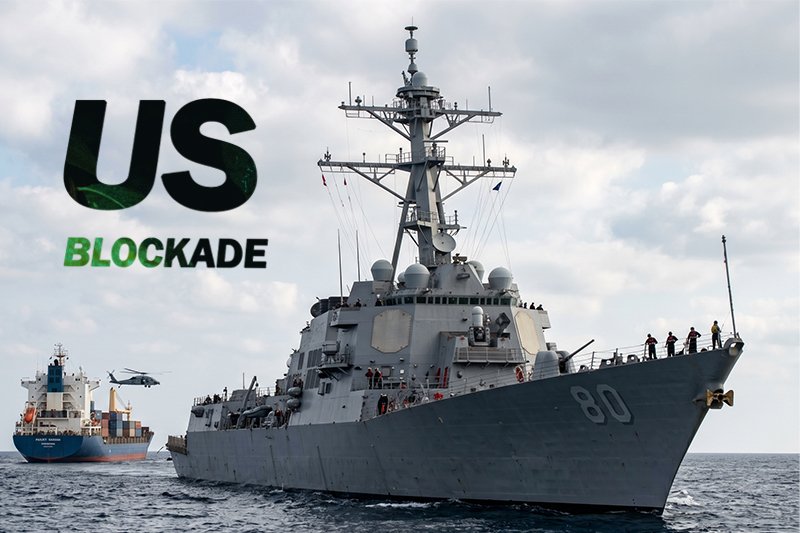
How US will enforce BLOCKADE and what impacts can it generate
The clash between Iran and US/ Israel that began on 28 Feb this year has spiraled into a bigger confrontation then as envisaged earlier. In the beginning of the strikes, US/ Israel were confident of the regime change to occur within a week or two; however, same could not materialize due their over optimistic calculations and vengeance of Iranian populace towards attack on their national identity.
In the aftermath of the failure of first strategy, plan shifted to wiping out the entire top leadership or Iran to render them without a decision making authority. It was believed that this strategy would cripple Iran’s Command and Control mechanism thus rendering their military element ineffective. However, this strategy also met the same fate as previous. The mosaic approach of command delegation to lower roots enabled Iranian forces to continue posing a sizeable challenge.
Thereafter, the strategy again shifted to taking out the credible infrastructure and economic associated productions to kneel down the ironing government for a pact. However, closure of Strait of Hormuz by Iran has rendered severe blow to this strategy, but also sent ripples across global commerce and shipping community.
In the meantime, efforts for mediation by global community especially Pakistan and Turkiye took a positive swing and Islamabad Talks were held in Pakistan directly placing the belligerents face to face. This afforded a first ever high level meeting between two sides in their 40 years confrontational history. The first round of talks remained inconclusive, however, both sides showed positive intent towards continuing further in future.
In response to the non-agreement between US and Iran, US has announced a blockade in Strait of Hormuz to put pressure on Iran for a favorable bargain in next round of talks likely to be held in Pakistan in third week. Two separate stances of US president and US CENTCOM has also made this situation interesting to observe as how that blockade will be enforced.
Read Me: Pakistan’s Moment at Sea: From Mediator to Maritime Architect
US President Trump had announced that blockade would be enforced immediately after talks with Iran failed. However, later clarified it during interview to Fox News that it could take a while. Subsequently, U.S. Central Command later announced the timing of the Strait of Hormuz blockade as announced by President Donald Trump, saying that the blockade of Iran’s ports will be enforced uniformly on April 13 at 10 a.m. (Eastern Time) on ships of all nations entering or leaving Iranian ports or coastal areas. It includes all Iranian ports located in the Gulf and Gulf of Oman. The statement added that
“CENTCOM will not obstruct the passage of ships passing through the Strait of Hormuz to or from non-Iranian ports.”
The US military says that once naval blockade of the Strait of Hormuz commence, any traffic from Iranian ports will be stopped, but ships coming from elsewhere will be allowed to pass through the waterway. However, according to the US Navy’s 2022 handbook, during this type of blockade, all naval traffic is prevented from entering or leaving certain ports, coastal areas or air bases that are under enemy control. This dichotomy is diabolical and seems to be intentionally tailored according to the current scenario and as per situational dictates and particulars of the conflict area peculiarities.
Shipping experts believe that blockade would only affect a small number of ships currently passing through the Strait of Hormuz. Very few ships are already passing through and most of ships are waiting to see if a peace agreement can be reached and then slowly increase the number of ships transiting this passage.
President Trump has said that other countries will join the blockade, but he did not specify which countries. He also said that US would also bring in ships that would remove mines, including British ships. This step is placed to ensure a safe passage to all ships transiting through Strait of Hormuz establishing a swept channel. President Trump’s statement is opined to be part of a strategy to pressure Iran into signing a deal on US terms.
However, a flipside yet to be answered is “what would be the response of countries that depend on Iranian oil. How they will respond to the American blockade”. Any step taken to uphold the barricade would intensify or escalate into another facet with other countries. In the meantime, Iran which used Strait of Hormuz to block the passage of certain ships has sent oil prices soaring in global market. Iran is also claimed to be receiving money from ships passing through Strait of Hormuz.
A million dollars question thus arises as how US blockade is going to evade these challenges which do not pose any physical entity to deal with. Ships and aircrafts can regulate or block a physical passage or ships, but cannot prevent a cascading effect on oil prices and shipping insurance price hike.
There are voices inside US as well against this practice. Senator Mark Warner, a Democrat member of the US Senate Intelligence Committee says “I don’t understand how the blockade of the Strait of Hormuz will force Iran to open it.” Republican Congressman Mike Turner says “blockade is a strategy to resolve the closure of Strait of Hormuz by force” According to a public poll, 59% of Americans believe that outcome of this war is bad for America. The majority believes that American goals, such as opening the Strait of Hormuz, greater rights for the Iranian people, and a permanent shutdown of Iran’s nuclear program, have not been achieved.
It’s an interesting tussle to see whether Iran has more capacity to endure American and Israeli coercion or whether US can withstand growing international and internal pressure to bring this clash to an end.

Ms. Safia Noor
Research Assistant
Ms. Safia Noor serves as a Research Assistant at the National Institute of Maritime Affairs (NIMA). Her work focuses on contributing to academic and strategic research within the maritime domain.
Catch all the latest defense news from around the world—join us on Facebook, Twitter, YouTube, Instagram & TikTok.