



HAVELSAN’s BLUEVISION Brings AI Eyes to the World’s Navies
Keeping watch over open water has never been simple. A drifting log, a small boat with its transponder switched off or a person struggling in rough seas can all slip past even a well-trained crew, especially at night or in poor visibility. Radar and AIS have carried the load for decades, but neither one tells the full story on its own. Turkish defence technology company HAVELSAN thinks it has found a way to fill that gap, and it’s called BLUEVISION.
What BLUEVISION Actually Does
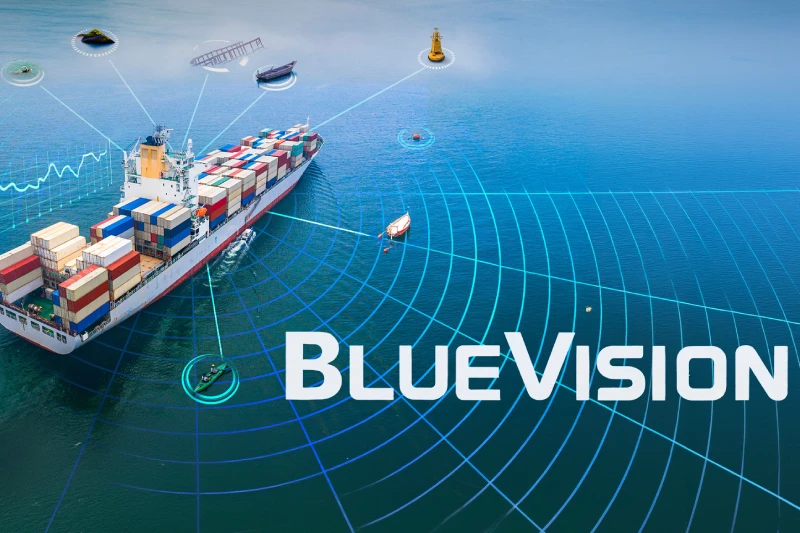
At its core, BLUEVISION is an AI-powered maritime awareness system that gives crews and operators a visual layer on top of their existing sensors. It pulls together electro-optical cameras, artificial intelligence and sensor fusion into a single screen, so an operator doesn’t have to jump between a radar display, an AIS feed and a raw camera image to figure out what’s actually happening around the vessel.
The system watches for small boats, buoys, floating debris and people in the water. It doesn’t just flag a blob on a screen either. Using real-time image analysis, BLUEVISION classifies what it sees, works out roughly where it is and highlights anything that might need a second look. Every object inside the camera’s field of view can be tracked at the same time, each one turned into a proper track with position data and a risk score attached.
Because it runs on both thermal and daylight cameras, the system doesn’t stop working when the sun goes down. And since the information overlays directly onto the live video feed, operators get context without losing sight of what’s actually in front of them.
Already at Sea
This isn’t a concept still waiting for its first trial. BLUEVISION is running on the SANCAR Armed Unmanned Surface Vehicle, which joined the Turkish Naval Forces in 2026 under a programme managed by the Presidency of Defence Industries (SSB). Paired with HAVELSAN’s ADVENT Combat Management System, it plays a role in autonomous navigation and mission execution through real-time detection, tracking and risk assessment. The system has already been through collision-avoidance and search-and-rescue focused testing as part of that programme.
HAVELSAN hasn’t kept BLUEVISION locked to a single platform. Through cooperation with VN Maritime and Piloda Shipyard, the technology has also made its way onto RAFNAR boats. On the commercial side, it’s being used aboard container vessels that operate in demanding navigation environments, proof that the same underlying tech has value well beyond naval decks.
Read this: HAVELSAN Signs Cooperation Agreement with Belgian Technology Company EURAMEC
A Digital Lookout That Doesn’t Get Tired
One of the more practical benefits of BLUEVISION is how it behaves as a digital lookout. Spot a potential collision risk or a navigational hazard and it raises the alarm through visual and audible warnings, rather than waiting for a crew member to notice. That matters most during long, monotonous watches, where human attention naturally drifts. In search-and-rescue and autonomous missions that demand hours of continuous video monitoring, that drop in attention is exactly the kind of failure point BLUEVISION is designed to catch.
For military users specifically, the system supports safe navigation, collision avoidance and the tracking of unidentified contacts. It’s built to pick out dark boats that have deliberately gone quiet and to visually verify AIS data that looks spoofed or misleading. In situations where radar or other active sensors need to stay off to avoid detection, BLUEVISION’s passive electro-optical approach offers a way to keep watch without giving away a vessel’s position.
Built to Grow
BLUEVISION isn’t locked into one mission set. HAVELSAN has designed it to be configured for ISR work, search-and-rescue operations and even submarine periscope observation, and because it’s built on a software-based architecture, new capabilities can be added later without a hardware overhaul.
It’s a good example of where HAVELSAN’s broader experience in combat management systems, autonomous platforms and maritime technology is heading: fewer isolated tools competing for an operator’s attention and more systems that quietly do the watching, so people can focus on the decisions that actually need a human judgment call.
Catch all the latest defense news from around the world—join us on
Facebook, Twitter, YouTube, Instagram & TikTok.