



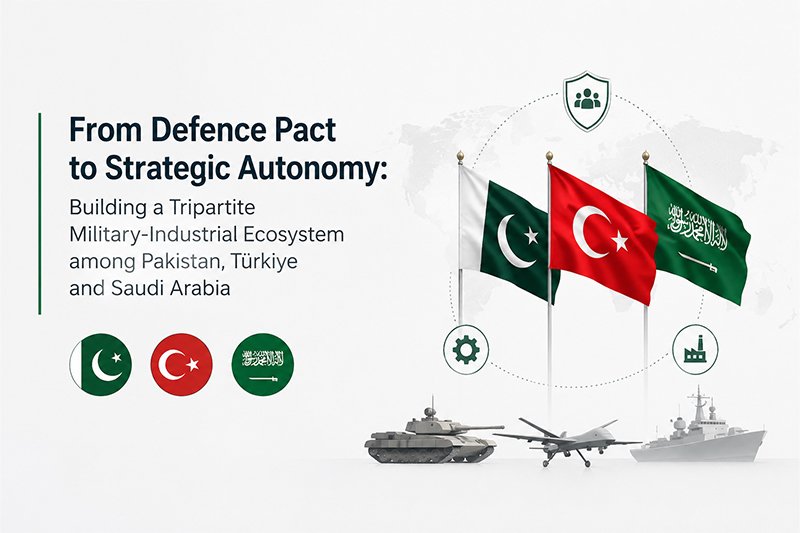
From Defence Pact to Strategic Autonomy: Building a Tripartite Military-Industrial Ecosystem among Pakistan, Türkiye and Saudi Arabia
To effectively implement the regional tripartite defence pact commonly associated with the Makkah Al-Mukarramah Summit for Joint Defence, the three Middle Powers—Pakistan, Türkiye and Saudi Arabia—must move beyond conventional military cooperation and initiate integrated Military Technology and indigenous Defence Industrial Programmes and Projects. Such an approach should draw lessons from the evolving defence-industrial initiatives being pursued within NATO, including the strategic direction and agreements announced during the recently concluded NATO Summit held in Istanbul, Türkiye. The objective should be to strengthen political alignment and defence cooperation into sustainable indigenous capabilities, technological resilience and long-term strategic autonomy.
With excessive dependence on extra-regional military paraphernalia—whether Western, Russian or Chinese—a Middle Power cannot fully exercise autonomy in strategic decision-making or maintain complete independence in the formulation and execution of its military plans. The equation becomes further complex when a State announces to defend another Ally; void of its own military technologies, infrastructure, spare supportability and supply chain. External dependence creates vulnerabilities in highly competitive and sensitive areas such as technology access, maintenance, spare parts, ammunition, software, upgrades, interoperability and the political conditions attached to defence supplies and their usage in some other theatre of War. Genuine strategic autonomy therefore requires not merely the acquisition of advanced platforms, but the indigenous capacity to sustain, modify, upgrade, employ and deploy them. These critical requirements become vulnerabilities without independent developing critical military technologies.
It’s not a mere idea but key ingredients are already available. Türkiye, a linchpin in NATO’ and EU’ military programs, provides important model in this regard. Around 10 Turkish defence companies—including TAI, Baykar Technologies, ASELSAN, HAVELSAN and ROKETSAN etc—have emerged among the world’s leading defence-technology manufacturers. Türkiye has progressively developed a comprehensive defence-industrial ecosystem encompassing research and development, design, prototyping, manufacturing, systems integration, testing, exports, technological innovation, marketing, branding and financial solutions. This interconnected ecosystem, supported by an increasingly assertive Political vision, efficient institutional framework and highly embedded industrial network, represents a strong prototype of an effective and rising Military-Industrial Complex (MIC) capable of generating both military capability and strategic-economic influence.
Saudi Arabia has also embarked upon an ambitious defence-indigenisation trajectory through the establishment and development of Saudi Arabian Military Industries (SAMI), with a strategic focus on defence localisation, research and development, technology transfer and indigenous manufacturing. Pakistan, meanwhile, possesses considerable foundations for a national and potentially collaborative defence-industrial ecosystem through institutions and organisations such as GIDS, HIT, PAC and DEPO. More importantly, Pakistan possesses a robust military, with extensive operational experience across multiple dimensions of modern warfare, including strategic, conventional, sub-conventional, counter-terrorism and hybrid warfare. This combination of institutional knowledge, technical expertise and operational experience constitutes a significant strategic asset for any collaborative defence-industrial framework. Further, Pakistan has been profited through Turkiye’s Hi-Tech Military Solutions and has been fast integrating Turkish systems into its Military Doctrines and Tactics; a rare advantage that can further act as X Factor.
In essence, the three countries bring complementary strengths to the table. Türkiye possesses an established and rapidly expanding defence-industrial base, with defence exports reaching approximately $15–20 billion in recent years; Saudi Arabia can provide substantial economic resources, investment capacity and a strategic vision for defence indigenisation; while Pakistan contributes a technically skilled human-resource base, established defence-production institutions and a battle-hardened military with extensive operational experience. The strategic convergence of these three comparative advantages could create an industrial and technological ecosystem considerably greater than the sum of its individual components.
The opportunity, therefore, is to move from transactional defence cooperation towards institutionalised co-development and co-production. The three Middle Powers could establish a structured framework for joint R&D, technology development, defence manufacturing, technology transfer, testing and evaluation, intellectual-property sharing, supply-chain integration and defence exports. Priority could be accorded to emerging and niche technologies—including unmanned systems, autonomous platforms, artificial intelligence, electronic warfare, cyber capabilities, precision systems, advanced sensors, counter-UAS technologies and network-centric warfare. Such cooperation would not only strengthen military interoperability but also create indigenous technological depth and reduce strategic dependence on external suppliers.
Read Me: “Deleted: Pakistan”, A New Maritime Era for Pakistan’s Business Community
Ultimately, the strategic value of the proposed partnership should not be measured merely through diplomatic optics, joint exercises or the projection of deterrence. Credible deterrence is ultimately underwritten by the ability to sustain military power independently. Sovereignty in defence decision-making requires sovereignty over critical technologies, production capabilities, supply chains and sustainment. An integrated Pakistan–Türkiye–Saudi Arabia Military-Industrial Complex—or a closely connected defence-industrial ecosystem—could therefore provide the technological and industrial foundation necessary to convert political alignment into durable strategic capability.
In a nutshell, the three countries possess complementary strategic ingredients: Türkiye offers industrial capacity and technological innovation; Saudi Arabia offers capital, investment and a strategic vision for indigenisation; and Pakistan offers technical human resources, established defence institutions and extensive operational experience. The challenge is now to institutionalise these strengths through a coherent, long-term and commercially viable framework for joint defence-industrial development. This would transform the partnership from a conventional security arrangement into a potentially consequential model of Middle-Power strategic autonomy, defence sovereignty and indigenous deterrence.
Author:
Ali Irfan: PhD IR Scholar at NUML, Pakistan. He has interests in Security, Military Technology, Foreign Policies, Blue Economy, Emerging Technologies and Political Economy.
Catch all the latest defense news from around the world—join us on
Facebook, Twitter, YouTube, Instagram & TikTok.
Very beautiful written, really enjoyed reading it.
Well written. So informative