


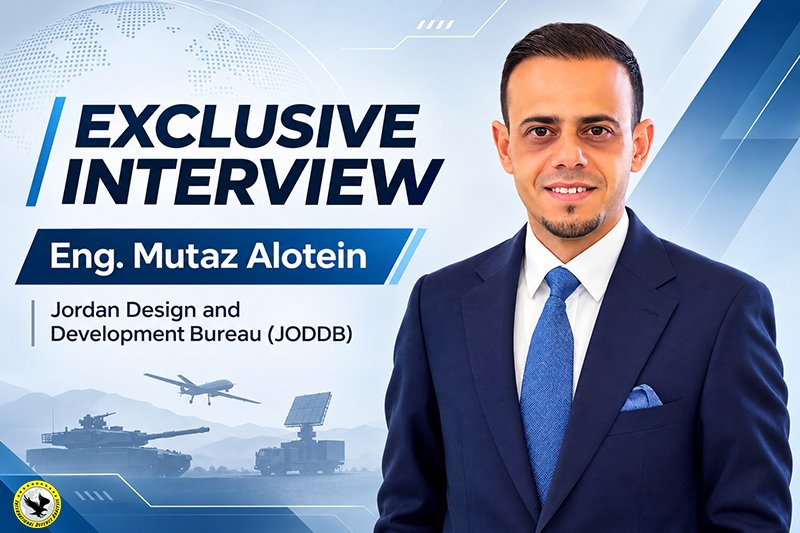
Exclusive Interview with Eng. Mutaz Alotein of Jordan Design and Development Bureau (JODDB)
Sir could you briefly introduce yourself and tell us about your professional background and current responsibilities at JODDB?
I am a mechanical engineer with around 15 years of experience in digital manufacturing, additive manufacturing, advanced engineering technologies and entrepreneurship. I hold a bachelor’s degree in Mechanical Engineering from the Hashemite University in Jordan, an MBA, and an MSc in Engineering Management from the United Kingdom. I have also completed a programme in Innovative Technology Management at the University of Oxford, and I have a strong interest in future technologies and how they will shape defence and industry. Today I serve as the Official Spokesperson for the Jordan Design and Development Bureau (JODDB) and its group of companies. I also head JODDB’s CAM and 3D Printing Center, where my team works on digital manufacturing, reverse engineering, rapid prototyping and new industrial solutions. Our aim is to strengthen Jordan’s advanced engineering and manufacturing capabilities and to give our armed forces and industry faster, more self-reliant ways to design, produce and sustain what they need.
What are JODDB’s main priorities for strengthening Jordan’s defence industry over the next five years?
JODDB’s priority is to make Jordan’s defence industry more self-reliant, more innovative and more competitive internationally. We will keep strengthening our four clusters: the Land Systems & Industrial Solutions Cluster, the Troops Gear & Armament Solutions Cluster, the Smart-Tech Zone Cluster, and the Support & Services Cluster. We are putting particular weight on disruptive technologies: artificial intelligence, counter-UAS and electronic warfare, cybersecurity, virtual and mixed reality, and 3D printing. Other priorities are shortening development cycles, raising local content and building deeper partnerships through our group of 13 companies and 7 business units. Above all, we want to develop Jordanian engineering talent, because the long-term strength of the industry rests on human capital as much as on equipment.
Which products and technologies is JODDB showcasing at SOFEX 2026 & what operational needs do they address?
At SOFEX 2026, JODDB showed a broad range of solutions built around the threats forces face today. For counter-UAS and electronic warfare, we presented Sky Storm C-UAS, Signal Striker and Mini Signal Striker, Silent Shield, Smart Sweeper, Kameen, Wave Hunter, Volt and our EOD Jammers. Our unmanned systems included the Al-Basheq VTOL UAV family, the Al-Dabbour loitering munition and The Hive. In land systems, we showed the Desert Ranger 4×4 vehicle and the Al-Tareq 120 mortar system. In training and digital technologies, we presented the Kill House, Al Miqnas – L, the E-War Planning Table, and the AR Catalog & MR Mechanical Simulator. We also launched two AI applications at the show. OWN is a bilingual conversational AI platform that helps analysts search, organise and analyse information, and Digital Spider collects and analyses open-source intelligence. Together, these address force protection, the drone threat, situational awareness, faster decision-making and realistic, cost-effective training.
How is JODDB using 3D printing and advanced manufacturing to improve defence production and maintenance?
3D printing has become a strategic capability at JODDB. We use FDM, FFF, SLA, DMLS (metal printing) and binder jetting. With these we produce prototypes, functional parts and end-use components in polymers and metals. Our workflow starts with a CAD model or a 3D scan of an existing part, moves through reverse engineering and printing, and ends with dimensional inspection using 3D scanning and PolyWorks software. This lets our design teams go from concept to tested prototype in days rather than months. For maintenance, we can reproduce obsolete or hard-to-source parts locally, which keeps equipment operational. One example is Al-Dabbour, a tactical loitering munition developed and manufactured using 3D printing. That makes it light, low-cost, fast to manufacture and easy to adapt to different missions.
What results can you share from JODDB’s digital spare-parts warehouse initiative, particularly regarding production time, costs & supply-chain resilience?
We built our digital spare-parts warehouse on a simple idea: instead of storing physical parts, we store validated digital files and produce parts on demand. To make this work, JODDB developed its own digital manufacturing platform, joddb3d.com. Through the platform, parts are scanned or modelled, qualified, kept in a secure digital library and produced when and where they are needed. We have also partnered with AMFG to develop and automate our internal processes, from receiving a request through production and quality inspection to delivery. The results so far are shorter lead times for critical parts, lower costs of holding physical stock, and less dependence on foreign suppliers, especially for obsolete components that are no longer manufactured. Most importantly, it has strengthened supply-chain resilience, keeping systems operational even when global supply chains are disrupted. We are now expanding the platform to offer the same service to Jordan’s private sector, helping local industry benefit from digital manufacturing and on-demand production.
How does JODDB ensure that locally manufactured components meet military quality and reliability requirements?
Quality is built into every stage of our process, not checked only at the end. Locally made components are designed against the original specifications. Materials are selected for the operating environment, and every printed part is inspected with 3D scanning and metrology software to confirm its dimensions. JODDB’s Test & Evaluation Center is accredited by the United Kingdom Accreditation Service (UKAS) to ISO/IEC 17025:2017, with 581 accredited tests covering weapons, ammunition, armour systems, vehicles, and electrical and electronic systems. Products are validated against international standards before they enter service. Our Desert Ranger, for example, provides STANAG 4569 Level II ballistic protection. We also qualify parts in close coordination with the end user, the Jordan Armed Forces, so reliability is proven in real operational conditions and not only in the laboratory.
What opportunities does JODDB offer international partners in joint development, technology transfer and local production?
JODDB offers partners a complete path from joint research and development to localised production. Partners can co-develop products with our engineering teams, transfer technology to Jordan, and manufacture inside the Industrial Gate Free Zone (IGFZ). IGFZ is the first private free zone in the Middle East specialised in defence, security and high-tech industries. Our group already includes successful partnerships, such as Aselsan Middle East (AME), which shows how international know-how and Jordanian engineering capacity can work together to serve both local and regional markets. Partners also gain access to our Test & Evaluation Center, a skilled engineering workforce and Jordan’s strategic location connecting the Middle East, North Africa, Europe and Central Asia.
Which export markets are priorities for JODDB and what distinguishes its solutions from competing international offerings?
JODDB’s products have now reached 38 countries around the world, which reflects growing international confidence in Jordanian defence solutions. We will keep building on this presence, with particular focus on the Gulf and the wider Arab region, Africa, and friendly countries in Asia that face similar operational environments and threats. What distinguishes JODDB is that our products are proven under the conditions of our own region: desert, rough terrain and asymmetric threats. They are designed together with an armed force that uses them. We offer flexibility and customisation, competitive cost, and responsive after-sales support and training. Our ability to adapt quickly, sometimes in weeks thanks to digital and additive manufacturing, is a real advantage over larger suppliers with longer development cycles.
Where do you see the strongest opportunities for defence industrial cooperation between Jordan & Pakistan?
Jordan and Pakistan have long enjoyed strong and friendly relations, built on mutual trust and respect. Our two countries share a common vision and complement each other in experience and capabilities. At JODDB, we value this relationship and believe there is real potential for meaningful cooperation in a range of fields that serve the interests of both nations. We look forward to every opportunity to strengthen these ties in the years ahead, for the benefit of both Jordan and Pakistan.
Looking ahead to 2030, what major developments should we expect from JODDB?
By 2030 I expect JODDB to be a regional leader in smart defence technologies. Artificial intelligence will be embedded across our products, from surveillance and decision support to autonomous systems. Digital manufacturing will be fully integrated into how the Jordan Armed Forces sustain their equipment. You should expect a wider family of unmanned and counter-unmanned systems, more advanced training and simulation solutions, and a larger share of products developed with international partners and exported to new markets. Most importantly, we will continue investing in young Jordanian engineers and innovators, who will carry this industry forward.
Read More Interviews


Catch all the latest defense news from around the world—join us on
Facebook, Twitter, YouTube, Instagram & TikTok.