



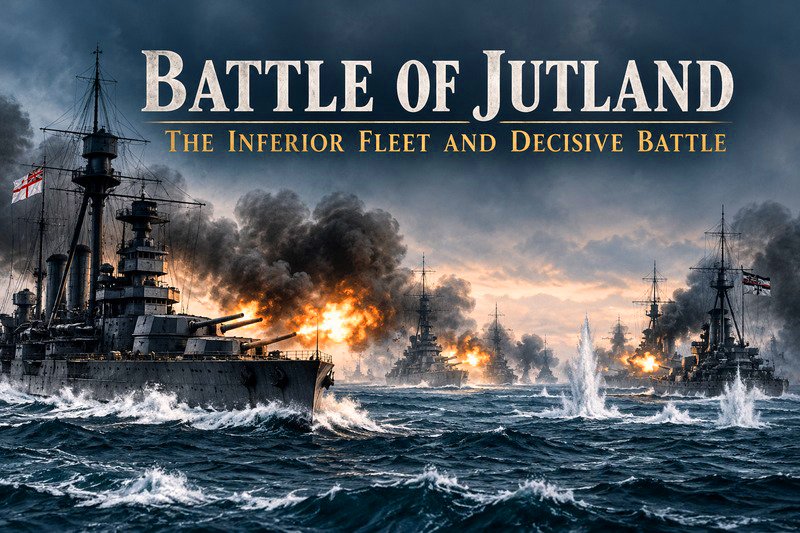
Battle of Jutland: The Inferior Fleet And Decisive Battle
Among naval battles, Trafalgar (1805) and Tsushima (1905) often receive greater attention than Jutland (1916). Yet all three were fleet battles of the kind envisaged by Mahan: Trafalgar and Tsushima produced the decisive results associated with his conception of fleet warfare, whereas Jutland did not; therefore it is sometimes seen as a “failed Trafalgar” by students of naval warfare. Yet this interpretation misses Jutland’s deeper significance, particularly for smaller and medium navies seeking to understand Mahan’s conception of decisive fleet action as the principal means of securing command of the sea. Jutland instead raises a different professional question: how does a relatively inferior fleet approach decisive battle against a superior one?
For a superior navy, the Mahanian logic (of decisive battle) carries an inherent advantage, as it possesses a greater combat power, can absorb losses more readily and can sustain operations for longer. It may also exercise greater influence over when and where battle occurs. An inferior navy cannot assume these advantages. If it simply imitates the stronger fleet’s method, it enters battle on terms already favourable to its opponent. Its operational problem is therefore different: how can it create temporary superiority at the point and time at which decision is sought?
This problem became increasingly significant as Mahanian ideas influenced naval planning in the early twentieth century. Tsushima reinforced the attraction of decisive battle. In 1905, Japan’s destruction of the Russian fleet demonstrated the strategic consequences of achieving a decisive fleet victory. The experience subsequently contributed to the Japanese concept of Kantai Kessen, in which the climactic fleet engagement became a central organising principle for naval planning. The historical danger was not the study of Tsushima itself, but the transformation of a historically contingent success into a template for future war.
Germany developed a different response to the problem of British naval superiority. Alfred von Tirpitz’s Risikoflotte sought to construct a fleet sufficiently powerful to make confrontation with Germany prohibitively costly for Britain. The objective did not necessarily require outright destruction of the Royal Navy. Yet the First World War exposed the limitation of this approach. A powerful fleet could impose risk without possessing sufficient strength to control the strategic conditions of a decisive engagement.
Jutland represented the clearest expression of that dilemma. By 1916, the German High Seas Fleet remained substantially smaller than the British Grand Fleet. Admiral Reinhard Scheer nevertheless continued to regard the British fleet as the principal obstacle to German freedom of action. His solution was not simply to seek a symmetrical fleet encounter. He sought to manufacture favourable conditions for battle.
More from the Author: Beyond Information Operations: The Rise of Operations in the Information Environment (OIE)
The German plan attempted to draw portions of the British force into situations where they could be attacked before the Grand Fleet concentrated. Submarines were positioned along expected routes, airship reconnaissance provided information, and proximity to German bases offered additional advantages. The underlying logic was to offset numerical inferiority by creating local and temporary superiority.
This distinction is central. Inferiority does not necessarily require abandoning decisive battle; it requires changing the conditions under which decisive battle is attempted. Concentration, in this context, does not mean concentrating against the enemy’s entire fleet. It means concentrating sufficient combat power against an isolated or vulnerable portion of that fleet before the opponent can bring its full strength to bear.
The problem at Jutland was that the conditions could not be fully controlled. The two principal fleets eventually engaged, and German forces fought effectively and inflicted greater material losses on the British. Yet tactical success did not produce strategic decision. The Grand Fleet remained operational, while Britain retained its broader maritime position. Jutland therefore demonstrates the distinction between tactical advantage and strategic decision.
This is also why Jutland provides a useful corrective to lessons derived from Tsushima. Tsushima showed what decisive fleet destruction could achieve. Jutland showed the difficulty of achieving such a result when the opposing fleet remained capable of concentrating superior strength. The question consequently shifts from whether an inferior fleet should seek decisive battle to how it can create the conditions necessary for one.
Admiral Raoul Castex (of French Navy) provides a useful conceptual framework for examining this problem. Writing after the First World War, Castex retained the importance of command of the sea but treated it as relative rather than simply absolute. He therefore did not reduce naval strategy to a single climactic encounter. His emphasis on strategic manoeuvre, offensive action and concentration sought to enable a weaker fleet to perturb a stronger opponent, generate temporary local advantages and repeatedly create favourable opportunities.
Applied to Jutland, the Castexian perspective sharpens the central analytical question:
How did the German fleet attempt to generate relative superiority against a materially superior British fleet, and where did that effort succeed or fail?
The answer extends beyond familiar discussions of battlecruisers, signalling, gunnery, or command decisions. It concerns the operational mechanisms through which an inferior fleet can compensate for aggregate weakness: intelligence, deception, manoeuvre, timing, geography, tactical disposition and supporting capabilities. These mechanisms do not eliminate inferiority. They seek to prevent aggregate inferiority from determining every local engagement.
Jutland should therefore be studied alongside Trafalgar and Tsushima, not because the three battles produced equivalent outcomes, but because they expose different dimensions of decisive fleet warfare. Trafalgar illustrates decisive action from the position of naval superiority; Tsushima demonstrates the strategic consequences of fleet destruction; Jutland exposes the problem of seeking decision from relative inferiority.
For students of naval warfare, this makes Jutland particularly valuable. As Hashmi highlights, the relative invisibility of maritime warfare has contributed to a broader tendency to understand war through land-centric concepts, making cases such as Jutland particularly valuable for recovering the operational logic of naval warfare. So, any concept revolving around the theories of A.T. Mahan, or more importantly, of decisive battle, is incomplete if examined only from the perspective of the fleet expecting to be stronger. The harder professional problem is how the weaker fleet constructs temporary superiority at the decisive time and place.
Jutland is therefore not simply a failed Trafalgar. It is a historical laboratory for understanding how an inferior fleet can attempt to fight a decisive battle without allowing the opponent’s aggregate superiority to determine the terms of engagement.
Disclaimer:
The views expressed in this article are solely those of the author and do not necessarily reflect the official views or policies of any affiliated institution.
About Author:
Zaeem Shabbir is an aerospace engineer. His interdisciplinary research bridges defence/strategic studies with aerospace engineering.
Catch all the latest defense news from around the world—join us on
Facebook, Twitter, YouTube, Instagram & TikTok.