







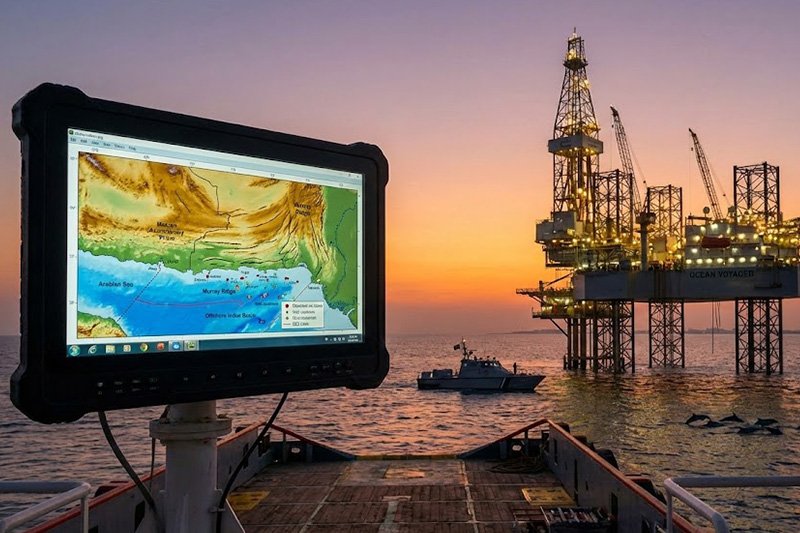
Drilling Ahead: Offshore Energy, Security and Environmental Protection in Arabian Sea
Pakistan’s energy sector is re-emerging on the national and international stage after years of problems from shortages and uncertainty. To most of Pakistanis, it is the rapid expansion of domestically-generated solar power which is expected to cross 19% of total electricity generation by June 2026. However, it is at sea where much bigger potential lies: the award of 23 offshore oil and gas exploration blocks in the Arabian Sea to four consortiums led by local energy companies represents a significant milestone, positioning offshore exploration as a potential boom for the country’s hydrocarbon sector.
This potential economic opportunity from offshore exploration, however, also raises a critical and often overlooked concern: Pakistan’s preparedness to prevent, manage, and mitigate the risks and challenges that will emerge as offshore hydrocarbon exploration moves from contracts toward operationalization.
The Exclusive Economic Zone (EEZ) and Continental Shelf have an area of 290,000 sq km, more than 1/3rd of Pakistani land area. The largely unexplored seabed consists of diverse geological zones, ridge-like structures and adjacent abyssal plains, whose complexity effects the feasibility of exploration and environmental concerns. An important feature in Pakistani EEZ is the Murray Ridge, which extends southwest from the Makran coast, as shown in chart.
The aforesaid ridge is a tectonically active seabed feature that was formed by interactions between the Arabian and Indian plates, and is of scientific interest for geological studies and potential offshore resources. Towards its East, Pakistan’s Indus Offshore Basin has long been regarded as underexplored despite geological similarities with hydrocarbon-rich regions across the Arabian Sea. Offshore exploration in this region was initially undertaken in 1963 by drilling of three wells in the shallow waters of the Indus Delta, at Dhabo, Patiani, and Korangi Creeks.
The recent awards (of offshore exploration) have attracted investment, technology and employment under a bigger aim of potentially reducing reliance on imported energy, strengthening of energy supply resilience, and easing of foreign exchange pressures. Yet, offshore exploration is not merely an undertaking of techno-economic nature; it is also an environmental and security challenge that demands conscious efforts and governance.
Such challenges also have potential to impact 1,000+ km coastline of Pakistan, where the livelihoods of coastal communities depend on the sea. Therefore, development of offshore energy potential must be understood not only in techno-economic terms, but also through the lens of human and environmental security, about governance, sustainability, and potential problems/ concerns for coastal communities. Two such concerns are explained below:

Figure Reference: Saif Energy Limited. Approximate positions shown.
- Environmental risks are the foremost of concerns, as oil spills pose a severe threat to marine ecosystems and coastal livelihoods. Even exploratory drilling can result in accidental discharges, blowouts, or operational spills. While the key details (on environmental risks, spill plans, and emergency protocols in event of pollution accident) may not be fully clear to the public, any such event can disrupt fisheries, damage mangroves and coral communities, and undermine coastal economic activity in the biologically rich waters of the Arabian Sea. Pakistan recently concluded its oil spill and pollution response exercise, BARRACUDA XIII. However, it reflected partial Tier-II preparedness, highlighting the need to expand national capacity to manage larger, more complex pollution incidents.
- Beyond technical and environmental risks, the process may also face challenges of public trust/ acceptance. Grievances from coastal community or their lack of trust can lead to social conflict, as demonstrated by the case of piracy in Nigeria. Coastal communities in Sindh and Balochistan, who rely on marine resources, have a legitimate stake in these activities. Yet they are rarely informed or consulted about environmental safeguards, emergency preparedness or benefit-sharing. Visibility and engagement are essential for governance and for ensuring that offshore ventures are socially sustainable, with communities treated as stakeholders rather than afterthoughts. The government, therefore, has both a responsibility and an opportunity to proactively disclose information, engage local actors and demonstrate that economic development will not come at the cost of environmental degradation or social marginalization.
Also Read: Pakistan-Iran Strengthen Defense Ties Through Naval Cooperation
Besides the above, offshore energy infrastructure also increases some critical physical security requirements. Pakistan’s EEZ does not entail a uniform threat profile. In the eastern side of EEZ; traditional, state-centric threats dominate due to proximity with India, thus putting conventional security in focus in this region. On the western side, it is the non-traditional threats from non-state actors (such as sabotage, terrorism, and maritime crimes), that require a broader, comprehensive security approach.
The authors opine that the Murray Ridge may also mark the transition between these two zones. This spatial distinction of security environment highlights the need that the development of naval and PMSA capabilities may be regionally tailored, with a state-centric focus in the east and a comprehensive security orientation in the west.
To conclude, the discovery of offshore energy has the potential to transform Pakistan’s energy landscape, strengthen resilience, and reduce dependence on imports. However, this opportunity comes with responsibility. There is a need to strengthen and enforce environmental safeguards, engage coastal communities in a timely manner as beneficiaries, and closely assess changes in the security environment to tailor measures according to the threat profile across the EEZ. Timely and coordinated actions today are essential to ensure that a potential opportunity does not turn into liability in longer run.
Usman Zafar Bhatti & Zaeem Shabbir
************************************
Courtesy: Pakistan Observer
Catch all the latest defense news from around the world—join us on Facebook, Twitter, YouTube, Instagram & TikTok.
Discover more from International Defence Analysis
Subscribe to get the latest posts sent to your email.