



DARPA Completes RACER Autonomous Vehicle Testing
DARPA, the Pentagon’s research and technology arm, confirmed on January 14, 2026, that its Robotic Autonomy in Complex Environments with Resiliency (RACER) program has successfully completed final operational tests and is ready for transition to US military units and commercial users. The announcement follows a comprehensive series of Army and Marine Corps demonstrations that proved RACER-equipped vehicles can operate autonomously in complex, off-road terrain without GPS navigation or pre-mapped routes while maintaining mission-relevant speeds.
DARPA emphasized that the results fulfill the original promise of its groundbreaking 2004–2005 Grand Challenge, which sought to accelerate the development of autonomous ground systems for military applications. This achievement represents a transformative milestone in military robotics, delivering practical battlefield capabilities that reduce risk to personnel while maintaining operational effectiveness.
Enables Multi-Platform Integration
RACER is not a single vehicle program but rather a sophisticated reusable autonomy software stack consisting of advanced algorithms, extensive datasets, and neural network models that can be installed on multiple types of ground vehicles. DARPA indicated the system can transform sensor-equipped platforms into fully autonomous vehicles capable of navigating contested and degraded environments without human control or intervention.
This modular approach provides enormous flexibility, allowing military services to apply proven autonomy technology across diverse vehicle types ranging from small reconnaissance platforms to heavy engineering equipment. The software-centric architecture reduces procurement costs by eliminating the need to develop unique autonomy systems for each vehicle class while simultaneously accelerating fielding timelines through leveraging mature, tested technology.
Combat Breaching Demonstration Validates Battlefield Application
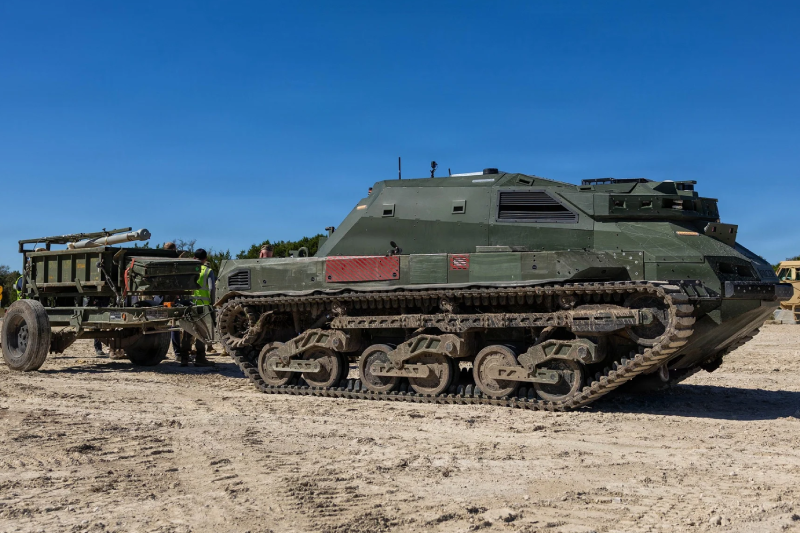
In October 2025, DARPA partnered with the U.S. Army’s III Armored Corps and the 36th Engineer Brigade during a combat breaching demonstration conducted under the Machine Assisted Rugged Soldier program. The Army employed the RACER Heavy Platform, built by Carnegie Robotics on a Textron M-5 chassis, and paired it with an M58 MICLIC rocket-projected mine-clearing line charge to autonomously clear a lane through a simulated minefield. “Our focus on real-world performance will translate directly into tangible benefits for military users,” stated Stuart Young, RACER program manager at DARPA.
“The combat breaching demonstration proved not just what technology can do, but how it can change the future of force protection.” This capability directly addresses one of warfare’s most dangerous tasks, removing soldiers from immediate proximity to explosive hazards while maintaining operational tempo during breaching operations.
National Training Center Exercise
In November 2025, soldiers from the 11th Armored Cavalry Regiment employed RACER-equipped vehicles as an opposition force during a rigorous live force-on-force exercise at the National Training Center in Fort Irwin, California. The unit utilized RACER Fleet Vehicles based on the Polaris RAZR platform to conduct autonomous long-range reconnaissance missions with integrated intelligence, surveillance, and reconnaissance payloads.
“By decreasing reliance on GPS and pre-programmed paths, RACER ensures warfighters can deploy autonomous assets in any environment, even when operating off the grid,” Young explained. “Instead of human scouts going 12 or 15 kilometers into enemy territory, that dangerous work can be handled by a robot while humans are safe.” Sergeant First Class Gavin Ros of the 11th Armored Cavalry Regiment confirmed the system met operational requirements during the exercise, stating, “I think it’s a great system; [RACER is] working very well for what we need it to.”
Advanced Perception Architecture
DARPA identified one of RACER’s main achievements as its sophisticated perception architecture, which allows autonomous vehicles to predict terrain characteristics and adjust behavior appropriately in uncertain environments. Unlike earlier autonomous systems that required weeks of retraining when deployed to new terrain, the RACER system can adapt to unfamiliar environments in approximately one day, according to DARPA, enabling rapid redeployment to diverse operational theaters.
“We make predictions about the world based on the evidence that we’ve seen and our prior information and can adjust even in ambiguous situations,” Young explained. “So part of that adaptation is learning the new environment.” DARPA validated this perception system during its final RACER experiment at the Fort Irwin National Training Center, completing eight major experiments conducted throughout the program’s lifespan that progressively demonstrated increasing autonomy sophistication and reliability.
Also read this: Germany Approves MQ-9B SeaGuardian Drone Acquisition
Dual-Use Technology Enables Commercial Applications
With military testing successfully complete, DARPA announced the RACER autonomy stack is now ready for transition to the U.S. Department of Defense and to private industry for commercial exploitation. The agency noted that multiple companies have already emerged from RACER-funded research, including Field AI and Overland AI, which are developing commercial off-road autonomy systems for sectors such as agriculture, mining, construction, and transportation. DARPA emphasized the dual-use nature of the technology has attracted significant interest from private investors, as the same autonomy software used in military vehicles can be applied to commercial platforms with minimal modification.
The agency characterized the conclusion of the RACER program as the beginning of broader adoption rather than the end of its impact. This technology transition represents a return on taxpayer investment, as military-funded research generates commercial applications that enhance economic productivity while simultaneously maintaining American technological leadership in autonomous systems. The successful military-to-commercial technology transfer demonstrates DARPA’s continued effectiveness in accelerating breakthrough innovations that serve both national security and economic competitiveness objectives.
Catch all the latest defense news from around the world—join us on Facebook, Twitter, YouTube, Instagram & TikTok.
Discover more from International Defence Analysis
Subscribe to get the latest posts sent to your email.