




Kuwaiti F/A-18 Hornet shoots down F-15E Strike Eagles
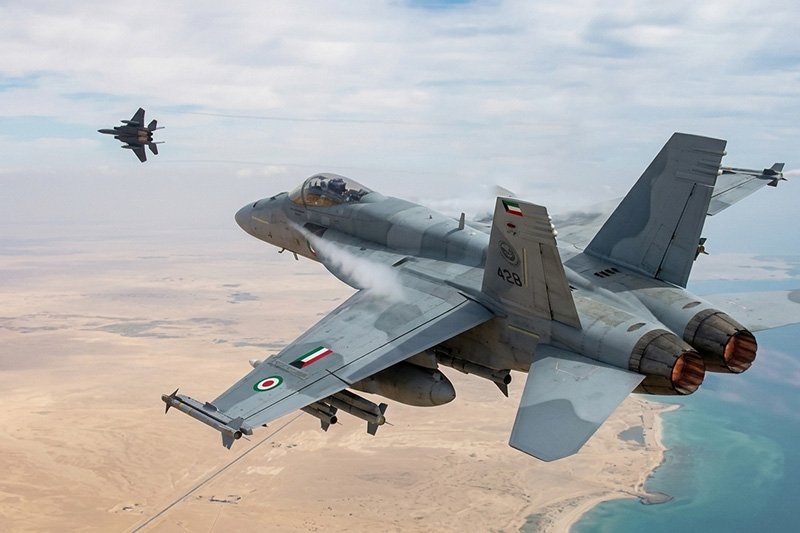
In a shocking development that has sent ripples through military aviation circles, a Kuwaiti Air Force F/A-18 Hornet is reportedly responsible for shooting down three United States Air Force F-15E Strike Eagles in what is now being described as a tragic blue-on-blue incident. The report, attributed to Wall Street Journal correspondent Lara Seligman and based on three separate sources with access to early incident briefings, points to a single Hornet firing three missiles one for each Strike Eagle.
While the loss of all three aircraft is a devastating blow, there is one silver lining: every single crew member survived.
How Did a Single Kuwaiti Hornet Take Down Three Strike Eagles?
According to the initial report, the Kuwaiti F/A-18 Hornet launched three missiles in rapid succession, bringing down each of the American jets one by one. The incident unfolded during a high-pressure situation in which multiple Iranian drones were actively penetrating Kuwaiti airspace. That chaotic backdrop fast-moving threats, multiple aircraft in the same airspace, and an urgent need to neutralize targets likely played a significant role in the tragic misidentification.
One of those Iranian drones reportedly struck a military installation, resulting in the deaths of six American servicemembers. The combined pressure of defending against drone threats in real time may have contributed to the confusion that led to the Hornet crew engaging the Strike Eagles.
Why the Air-to-Air Theory Makes Sense
Earlier speculation pointed toward a ground-based air defense system as the culprit. However, the air-to-air explanation is arguably more consistent with the physical evidence recovered from the wreckage particularly the damage pattern visible on one of the downed aircraft.
Video footage captured one F-15E spinning toward the ground with its vertical tail sections sheared off and its engines fully engulfed in flames. That level of structural damage, while catastrophic, does not neatly align with what you would typically expect from a large surface-to-air missile strike. Heavier ground-based systems tend to produce a different kind of destruction.
What makes the air-to-air scenario particularly compelling is that all three crews managed to eject and survive. That outcome is far more consistent with tail-aspect missile engagements using smaller, short-range weapons than with a direct hit from a high-powered ground-based SAM system.
Read this: Lockheed Martin Unveils Rapidly Developed Lamprey Drone
The Role of the AIM-9 Sidewinder — And Why the F-15E Crews May Not Have Known
One of the more troubling details buried in this story involves the type of missile potentially used. If the Kuwaiti Hornet employed AIM-9 Sidewinder missiles, heat-seeking weapons the Strike Eagle crews would have had virtually no warning before impact. Sidewinders do not require the launching aircraft to illuminate the target with radar. They simply lock onto the heat signature of an engine and follow it.
There is a caveat here. If the Hornet’s radar was used to assist in achieving the Sidewinder lock, the F-15E crews might have detected that they were being painted but in a battlespace already full of friendly radar emissions, being tracked by a nearby Kuwaiti aircraft probably would not have raised immediate alarm bells. The Hornets were, after all, operating in the same airspace and performing a legitimate defensive mission against the Iranian drones at the time.
That is precisely what makes this incident so devastating and so difficult to fully blame on any single point of failure.
Friendly Fire in Complex Battlespaces Is Not New — Especially Near Kuwait
As sobering as this incident is, it did not occur in a historical vacuum. Friendly fire involving tactical aircraft in complex, multi-threat environments has happened before — and Kuwait has featured in at least two prior incidents of this nature. The fog of war, the speed at which modern aerial engagements develop, and the near-impossible task of maintaining perfect situational awareness in a crowded airspace all conspire to create conditions where misidentification becomes a real and recurring risk.
Military aviation experts have long emphasized that the identification friend or foe (IFF) systems and communication protocols that are supposed to prevent these tragedies are only as reliable as the humans operating them under stress and in fast-moving combat scenarios, even well-trained crews can make catastrophic errors.
What Comes Next
Investigations into the incident are expected to examine everything from IFF transponder data and radar tracks to communication logs and the rules of engagement in place at the time. The findings will likely have significant implications for how coalition operations in contested airspace are coordinated going forward.
For now, the focus remains on the six Americans killed in the drone strike and on ensuring the wellbeing of the Strike Eagle crews who somehow walked away from what should have been unsurvivable encounters.
The Kuwaiti F/A-18 Hornet shoots down F-15E Strike Eagles story is still developing. As more details emerge from official investigations, the full picture of what went wrong over Kuwait that day will gradually come into focus. What is already clear, however, is that this incident will become a defining case study in the dangers of coalition airspace management in high-intensity conflict environments.
Catch all the latest defense news from around the world—join us on Facebook, Twitter, YouTube, Instagram & TikTok.
Discover more from International Defence Analysis
Subscribe to get the latest posts sent to your email.