



Completing the Maritime Picture: Why Regional Information Hubs Matter in the Strait of Hormuz Crisis
The recent op-ed on “Strait of Hormuz: Time for a Maritime Peacekeeping Operation?” by Christian Bueger, published on 24 March 2026 offers a compelling and well-structured analysis of one of the most consequential disruptions to global maritime trade in recent history. Its central argument that military solutions alone are insufficient to restore confidence in commercial shipping is both timely and analytically grounded. By highlighting the limitations of naval escorts, the risks of escalation and the promise of diplomatic mechanisms, the piece contributes meaningfully to ongoing policy debates.
Yet, while the analysis is robust in its global framing and institutional focus, it overlooks a critical layer in the evolving maritime security architecture: the growing role of regional information-sharing centers, particularly in the Indian Ocean Region (IOR). In an era where maritime threats are increasingly hybrid, decentralized, and fast-moving, the importance of maritime domain awareness (MDA) cannot be overstated. It is here that the omission becomes analytically significant.
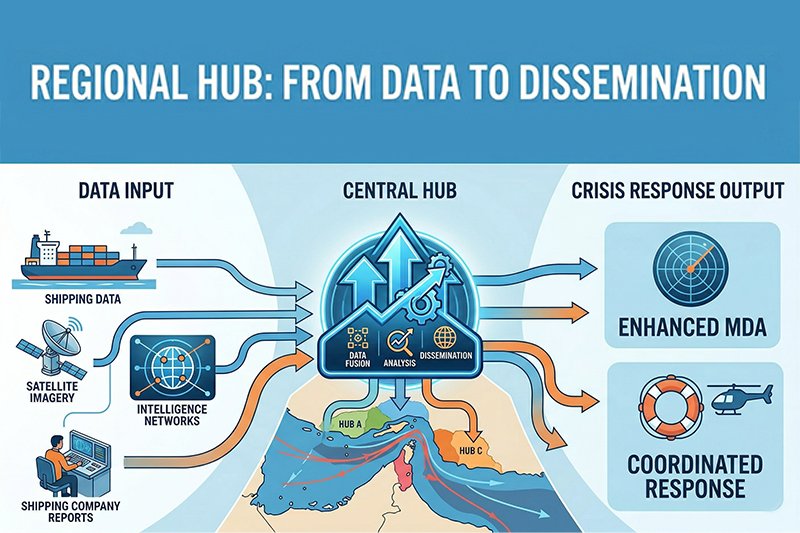
The op-ed rightly references established mechanisms such as US-led JMIC initiative under the Combined Maritime Forces, the Indian Navy’s Information Fusion Centre – Indian Ocean Region, the European Union’s Maritime Security Center – Indian Ocean, the Gulf Cooperation Council’s Unified Maritime Operations Center, and the UK’s Maritime Trade Organization. However, it does not account for Joint Maritime Information Coordination Center (JMICC) Pakistan, an emerging platform developed under the Pakistan Navy to enhance information integration and coordination among maritime stakeholders.
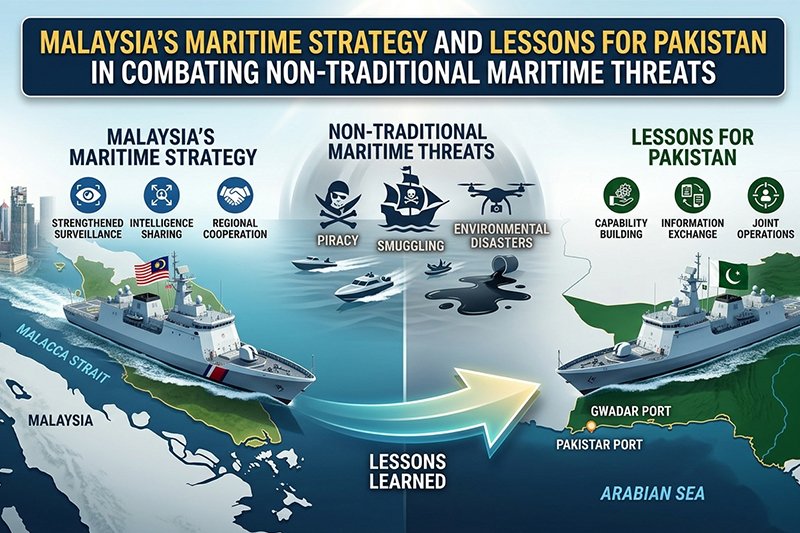
READ ME: Malaysia’s Maritime Strategy and Lessons for Pakistan in Combating Non-Traditional Maritime Threats
The future of maritime security lies not in a handful of centralized hubs, but in a distributed network of interoperable information centers, each contributing localized awareness to a shared operational picture. JMICC Pakistan, given its proximity to Gulf and its interface with critical sea lanes, is well-positioned to serve as a bridge between the Arabian Sea and Indian Ocean Region.
At a time when vessels face threats from drones, missiles, and irregular maritime actors, the ability to detect, interpret, and disseminate real-time information is as vital as physical protection. Information asymmetry, after all, is often what adversaries exploit. By strengthening early warning systems and facilitating coordinated responses, regional centers like JMICC can reduce uncertainty and restore a degree of predictability to maritime operations.
The op-ed’s emphasis on diplomacy and UN-led frameworks is well placed, particularly in light of the risks associated with escalation. However, multilateralism in maritime security must be understood more broadly. It is not confined to naval deployments or high-level negotiations; it is equally about technical cooperation, data sharing, and institutional connectivity.
In this context, the contribution of middle powers and regional actors becomes indispensable. Countries such as Pakistan and others in IOR are not merely stakeholders, they are security providers in their own right. Their participation enhances legitimacy, broadens ownership, and reduces the perception of great-power dominance, which can be particularly sensitive in politically charged environments like the Gulf.
Indeed, the endorsement of this perspective by Christian Bueger underscores a broader academic and policy consensus: that effective maritime governance today is networked, not hierarchical.
Looking ahead, any sustainable solution to Strait of Hormuz crisis must rest on a layered architecture comprising three interdependent components:
- Political Layer: Diplomatic engagement and potential UN Security Council mandates.
- Operational Layer: Naval deployments, escorts, and rules of engagement.
- Informational Layer: A network of maritime information-sharing centers, including JMICC Pakistan
The op-ed makes a strong case for the first two layers but gives limited attention to the third. This is a gap worth addressing, not as a critique of the article’s core argument, but as a necessary extension of it.
If Strait of Hormuz crisis has revealed anything, it is that maritime security is no longer defined solely by the presence of warships. It is increasingly shaped by flow of information, who has it, how quickly it is shared, and how effectively it is used.
In this evolving landscape, institutions like the Joint Maritime Information Coordination Center Pakistan are not peripheral additions; they are central to the system’s resilience. Recognizing their role does not detract from the op-ed’s argument, it completes it.

Dr. Waqas Khaliq Bhatti
Research Fellow at NIMA
Dr. Waqas Khaliq Bhatti is a Research Fellow with the National Institute of Maritime Affairs (NIMA) in Karachi. Expert in maritime strategy and regional security.
Catch all the latest defense news from around the world—join us on Facebook, Twitter, YouTube, Instagram & TikTok.
Discover more from International Defence Analysis
Subscribe to get the latest posts sent to your email.