







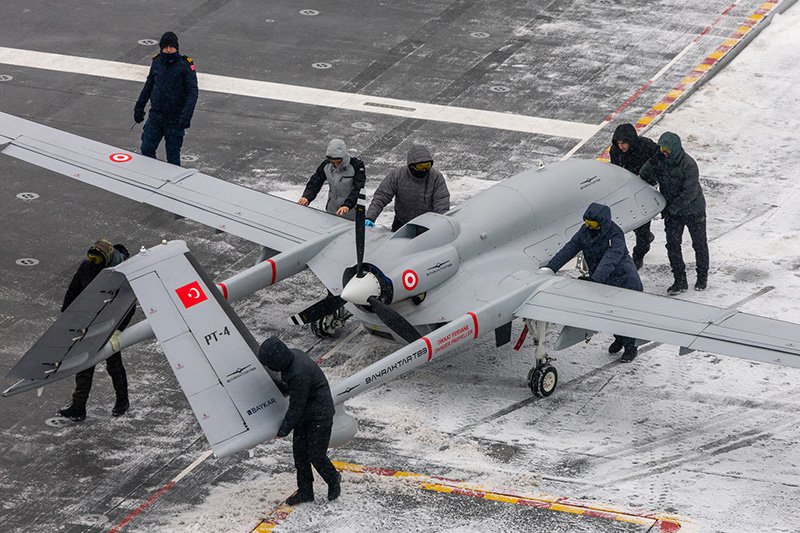
Bayraktar TB3 Proves Its Worth in Baltic’s Brutal Winter
When temperatures plunged to -5°C over the Baltic Sea and heavy snow blanketed the deck of TCG Anadolu, every other aircraft in NATO’s Steadfast Dart 2026 exercise was grounded. Every other aircraft, that is, except one.
The Bayraktar TB3 unmanned combat aerial vehicle (UCAV), developed by Turkish defense company Baykar, pushed off the short ski-jump deck of the amphibious assault ship TCG Anadolu, climbed into the freezing grey sky and completed its mission without a hitch entirely on its own.
That moment, witnessed by representatives of allied nations on February 14, 2026, near Kiel, Germany, quietly rewrote the rulebook on what carrier-based drones can do.
A Flight No Other Aircraft Could Make
Fierce Baltic winds, heavy snowfall, and sub-zero temperatures created conditions that NATO planners described as exceptionally challenging. Fighter jets and helicopters participating in the exercise remained on the ground. Yet the TB3 took off autonomously, maintained stable flight despite turbulent sea winds, and recovered safely on a runway that ground crews had to manually clear of ice beforehand.
It wasn’t just a technology showcase. It was a pointed demonstration that this drone can operate when human-piloted platforms cannot.
“As the only aircraft capable of flying in those conditions, the TB3 received full marks from our allied representatives,” a Turkish Navy spokesperson noted following the event.
The flight was part of NATO’s Steadfast Dart 2026 exercise, which ran from January 2 to March 18 and involved around 10,000 personnel from 11 member nations. Notably, no U.S. conventional forces participated a fact that drew considerable attention from analysts watching European defense self-sufficiency develop in real time.

What Makes the TB3 Different
At the heart of this story is Baykar’s proprietary two-component automatic landing system, which combines communications and image processing to guide the TB3 back to a moving ship — even in conditions that would challenge human pilots.
Baykar released detailed footage of the system’s interfaces during the exercise, offering a rare inside look at technology that most defense companies keep firmly under wraps.
The TB3 itself is purpose-built for short-deck naval operations. Its folding wings and reinforced undercarriage allow it to take off and land without catapults or arresting wires a logistical advantage that significantly broadens the range of ships it can operate from. Powered by a domestically developed 170-horsepower TEI-PD200 turbodiesel engine, the drone can stay airborne for more than 24 hours and carry up to 280 kilograms of ordnance across six hardpoints.

Key specifications at a glance:
- Length: 8.35 meters
- Wingspan: 14 meters
- Max takeoff weight: 1,600 kilograms
- Payload capacity: 280 kilograms
- Endurance: 24+ hours
- Service ceiling: 25,000 feet
- Engine: 170 hp turbodiesel, fully indigenous
The drone supports both line-of-sight and beyond-line-of-sight communication, and can carry laser-guided, INS/GPS-guided, infrared-guided munitions, and mini cruise missiles.
Hitting Targets with Precision — In the Cold
The Baltic demonstration didn’t stop at flying. The TB3 also conducted live-fire engagements, striking surface targets with MAM-L smart munitions in dual salvo attacks with pinpoint accuracy. These firings marked the first time in NATO history that a shipborne drone struck a target within a live exercise scenario.
General Ingo Gerhartz, Commander of NATO’s Joint Force Command Brunssum, was on board TCG Anadolu to watch a live-fire demonstration firsthand. He applauded the strike, then personally congratulated the crew alongside Turkish Naval Forces Commander Admiral Ercument Tatlioglu.
“As NATO Commander, I am very grateful to the Turkish Armed Forces for such an important and remarkable contribution to the Steadfast Dart 2026 exercise,” Gerhartz said.
One detail from that day went viral in defense circles: the munition fired bore the inscription “Blue Homeland knows no boundaries” a reference to Türkiye’s long-standing maritime doctrine.
232 Sorties and Counting
By the time observers tallied the numbers, the TB3 had completed more than 232 sorties from TCG Anadolu throughout the exercise. Every single takeoff and landing was performed autonomously.
The munitions tested during those sorties included MAM-L, MAM-T glide munitions, UAV-122 aeroballistic missiles, and Kemankes 1 loitering munitions a diverse enough weapons suite to cover everything from precision strikes to slower area-denial missions.
Admiral Tatlioglu framed the achievement in broader terms: “Türkiye is establishing a new doctrine for amphibious operations within the Alliance.” Using drones to soften coastal defenses before troop landings exactly what was practiced at Steadfast Dart is a concept NATO had never formally tested until now.
Read This: Turkish Defense Industry Uses AI to Upgrade Missile Systems
What This Means for the Alliance
For NATO, the TB3’s performance raises a straightforward but strategically significant question: why aren’t more navies doing this?
Several European nations already operate LHD-class vessels that could, in theory, embark similar systems. The establishment of LBA Systems — a joint venture between Baykar and Italian defense giant Leonardo — aims to certify the TB3 on Italian flight-deck ships by 2026, with European payload integration on the roadmap. That partnership could give EU navies access to an affordable, proven carrier-capable drone without the decade-long development cycles that typically accompany new military platforms.
Indonesia is another country watching closely. Already set to operate 60 Bayraktar TB3 UAVs, Indonesia is also scheduled to receive the decommissioned Italian carrier ITS Giuseppe Garibaldi — a ship that will, by design, be able to deploy the very same drone system.
Naval analyst Dr. Lee Willett put the wider implications plainly: “The key capability uncrewed systems bring for NATO at the moment is mass — especially for sensing. Navies across NATO are starting to see all surface ships of any type as drone carriers. Any platform that can bring uncrewed systems to the fight quickly adds operational advantage.”
Baykar’s Export Numbers Tell Their Own Story
The Steadfast Dart demonstration didn’t happen in a commercial vacuum. Baykar is currently the world’s largest exporter in the unmanned aerial vehicle segment, a position it has held for the past three years running.
In 2025, the company set a new record with $2.2 billion in exports — a remarkable figure for a company that has funded all its projects entirely from its own resources since its founding. Roughly 90% of Baykar’s revenue now comes from international sales.
Baykar has signed export agreements with 37 countries in total: 36 for the Bayraktar TB2 and 16 for the heavier Bayraktar Akinci. The company ranked among the top 10 exporters across all sectors in Türkiye in both 2023 and 2024, and has held the top spot in defense and aerospace exports in every year from 2021 through 2024, according to data from Turkey’s Defense Industry Agency (SSB) and the Turkish Exporters Assembly (TIM).
In 2023 alone, Baykar accounted for one-third of total Turkish defense and aerospace sector exports.
The Bigger Picture
Türkiye contributed roughly 2,000 personnel to Steadfast Dart 2026 — about one-fifth of the total exercise strength. The Anadolu Task Group, which also included the frigate TCG Istanbul, the modernized TCG Oruçreis, and the fleet oiler TCG Derya, deployed from the Eastern Mediterranean to the Baltic — a journey of approximately 8,000 kilometers — while carrying a full marine infantry battalion, amphibious armored vehicles, and naval special warfare units.
That kind of force projection, sustained over that kind of distance, is something only a handful of NATO navies outside the United States can currently manage.
As European security discussions intensify — from Munich Security Conference speeches about a “new world order” to French calls for a redesigned European defense architecture — Steadfast Dart 2026 offered something more concrete than political rhetoric: a demonstration of what NATO can actually do when it needs to, without American conventional support, in the coldest month of the year, at the edge of the continent.
The Bayraktar TB3’s flawless flight over the Baltic was, in that context, more than an aviation milestone. It was a statement.
Catch all the latest defense news from around the world—join us on Facebook, Twitter, YouTube, Instagram & TikTok.
Discover more from International Defence Analysis
Subscribe to get the latest posts sent to your email.