




Turkey’s Stand-Off Jammer Aircraft Takes to the Skies & Pakistan Is Taking Notes
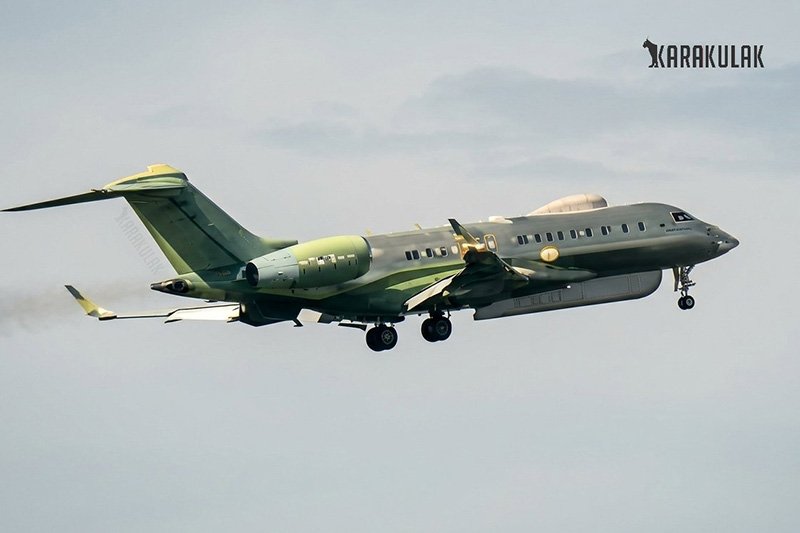
For the first time, Turkey’s highly anticipated stand-off jammer aircraft has been photographed in the air. The sighting marks a major step forward for a country that has spent years pushing hard to build its own electronic warfare muscle without leaning on foreign suppliers.
The aircraft broke cover on March 1, 2026, when a photographer captured it in flight near Turkish Aerospace Industries’ (TAI) facility in Ankara. Just days earlier, on February 20, two of the platforms had been tracked live during test flights under the call signs ‘THS41’ and ‘THS42’. The images spread quickly across Turkish defense circles and were picked up by the outlet TurDef.
What Exactly Is the HAVASOJ Program?
The stand-off jammer aircraft known as the Hava SOJ or ASOJ 23, A is a joint effort between TAI and Aselsan, Turkey’s leading defense electronics firm. The program involves converting four Bombardier Global 6000 business jets into full-spectrum airborne electronic warfare platforms.
The two airframes confirmed so far carry serials 9854 and 9855. Turkey acquired them between 2019 and 2020, and conversion work at TAI began shortly after. The Secretariat of Defence Industries (SSB) officially announced the arrival of the first airframe at the TAI facility back in March 2019.
Also Read: Turkish Defense Industry Uses AI to Upgrade Missile Systems
Turkish defense commentators and analysts have also referred to these aircraft under the ASOJ 23-A designation post-conversion. Either way, both names point to the same program.
The contract underpinning the electronics side of the program may trace back to a $18.9 million Electronic Warfare System Project deal signed between the SSB and Aselsan in December 2020. That agreement specifically mentioned Aselsan’s systems being integrated onto the Hava SOJ aircraft.
How Is the Aircraft Being Modified?
TAI holds responsibility for all structural work on the airframes. That includes both internal and external modifications changes to the Electrical Power Distribution System (EPDS), cooling systems, detailed component manufacturing, and full system integration. The company is also responsible for testing the impact of external changes on flight control and stall prevention, and for delivering all four aircraft with their Military Supplementary Type Certificates (STCs).
Inside the cabin, TAI partnered with Turkish Cabin Interiors (TCI) to design and install crew rest areas, lavatories, galleys, closets, and other interior fittings.
On the outside, photographs and AI-enhanced imagery show a large canoe-shaped fairing underneath the fuselage likely housing an antenna array along with dome-shaped dorsal antennae and antenna blades running along the spine and belly of the aircraft.
Additionally, the stand-off jammer aircraft is expected to carry Leonardo’s Miysis Directional Infrared Countermeasures (DIRCM) system for self-protection. That detail was reported in November 2021 and hasn’t been officially denied since.
What Role Will It Play?
In simple terms, a stand-off jammer aircraft does not fly into the teeth of enemy air defenses. Instead, it operates from a safe distance hence the name and uses high-powered electronic emissions to disrupt, blind, or deceive enemy radars and communications networks.
These platforms work alongside other special mission aircraft such as Airborne Early Warning and Control (AEW&C) jets and Intelligence, Surveillance and Reconnaissance (ISR) platforms. Together, they form the backbone of modern electronic warfare operations.
The ASOJ 23-A fits squarely within the same mission profile as the US Air Force’s EA-37B Compass Call, France’s Archange, and Australia’s MC-55A Peregrine. It monitors, intercepts, and jams radar and radio emissions from both ground-based and airborne systems. Some platforms in this category can also provide communications relay support to air, ground, and naval units.
Turkey’s push to develop this capability domestically reflects a wider national security philosophy. Sensitive electronic warfare technology is generally off-limits in the international arms market. Building it yourself is the only reliable path — and Turkey has made that choice clearly.
Pakistan Is Watching — And Moving
Interestingly, Turkey is not the only country looking to field the Global 6000 in this role. The Pakistan Air Force (PAF) has confirmed it is working with TAI to convert its own lone Bombardier Global 6000 into a stand-off jamming platform.
The PAF first hinted at this in its latest official calendar, where the aircraft was labeled an electronic warfare platform. The PAF’s unofficial publication, Second-to-None, later confirmed that conversion plans were firmly in place.
Given that TAI is already doing exactly this work for Turkey’s air force, it makes strong sense that the PAF would tap into the same production line and expertise. The most likely outcome is that Pakistan acquires a version of the Aselsan HAVASOJ suite either in standard form or customized to suit its budget and requirements.
Why Does Pakistan Need This Capability?
The PAF’s current jamming capability relies on the Dassault Falcon DA-20 electronic attack aircraft. That platform has served well, but it has limits. A Global 6000-based stand-off jammer would bring higher power output, longer jamming range, and the ability to operate at stand-off distances keeping the crew well away from threat envelopes.
Beyond raw power, there are other drivers. The PAF wants a platform capable of countering improved Electronic Counter-Countermeasures (ECCM) systems. It is also looking toward the future, with an eye on integrating artificial intelligence (AI) and machine learning (ML)-based technologies into its EW architecture.
This conversion does not exist in isolation. Pakistan is building toward a broader restructuring of its air wings. The PAF is reportedly exploring the Shenyang J-31 as its next-generation fighter a fifth-generation aircraft with stealth qualities that outpace its current F-16, J-10CE, and JF-17 fleets. New offensive wings will need new support assets. A stand-off jammer is one of the most critical pieces of that puzzle.
A Turning Point for Regional Electronic Warfare
Turkey’s stand-off jammer aircraft taking flight is more than a milestone for Ankara. It signals that mid-tier air forces those outside the traditional US-Russia-China axis are investing seriously in airborne electronic warfare. Japan recently announced its own EW platform development program. Pakistan is now entering the same space.
Electronic warfare is no longer a niche capability. It is central to how modern air campaigns are fought. Countries that cannot blind, deceive, or suppress an adversary’s sensors are at a structural disadvantage before the first missile is ever fired.
For Turkey, the HAVASOJ program is a statement of intent. For Pakistan, acquiring a version of the same capability would mark a meaningful leap forward. And for the region as a whole, the arrival of capable stand-off jammer aircraft in South Asia and the Eastern Mediterranean is something that air planners on all sides will be watching very carefully.
Catch all the latest defense news from around the world—join us on Facebook, Twitter, YouTube, Instagram & TikTok.
Discover more from International Defence Analysis
Subscribe to get the latest posts sent to your email.