

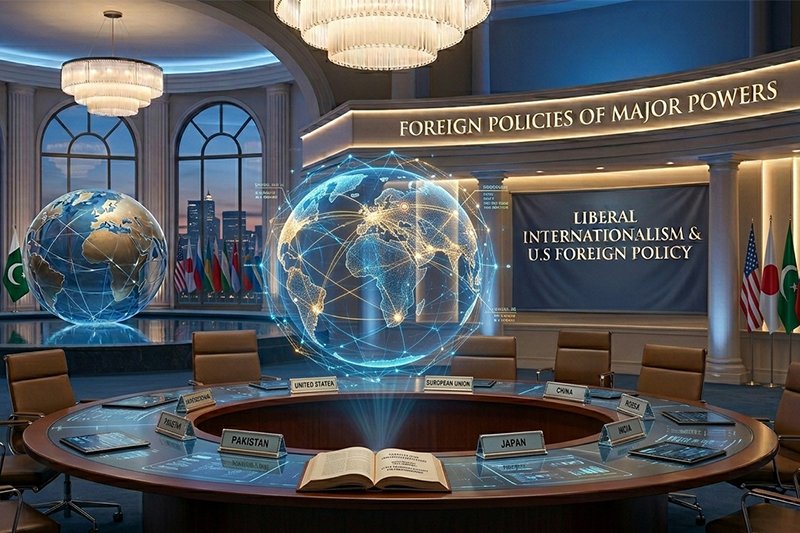




Series of Foreign Policies: Liberal Internationalism & U.S Foreign Policy
Liberal internationalism is defined as the practical manifestation of Liberal value system in the field of foreign affairs and foreign policy. Though it is rooted from Political Science’s theory of Liberalism, yet, it can be safely assumed that the concept of “Liberal Internationalism” is the outward extension and practical exhibition of the theory in the realm of International Relations, Foreign Policy, and how to build a Global Liberal Order.
Since the beginning of the 20th Century, liberal Internationalism has been one of the most potent idea and trend that has shaped, influenced and transformed the American foreign policy. Hence, the doctrine of Liberal Internationalism is the exporting and internationalizing the already domestically Internalized Liberal Values of enlightenment, rationality, human development, universal human rights, cooperation and Interdependence, rule based society, democratic governance, progressive social change, and free trade through multilateral institutions, politico-military and economic global and regional alliances, assertive diplomacy and military interventions etc (G. John Ikenberry, 2009).
The main assumption and postulate of this doctrine, trend and tradition is that States can be able to rise beyond the anarchic nature of international relations, which it has frequently used as an ideological guide and as a legitimating discourse to project power and influence throughout the world. Instead, States can interact positively for mutual progress, perpetual peace, collective wisdom and collective human dignity beyond any biases and prejudice.
It is impossible to overestimate the salience of liberal internationalism in the American strategic culture. Since the establishment of the post-World War II liberal order, embodied in the United Nations, the Bretton Woods institutions, and NATO, liberal concepts have repeatedly been reflected in the definition of the interests of the Washington and the reasons why the state has taken actions in foreign countries (Mearsheimer, 2018).
This assignment explores the intellectual roots of liberal internationalism, its development in the U.S. foreign policy since Wilson to the Obama, Biden and Trump administrations, its contradictions with rival paradigms, and its future in modern times. The exposition is based on theoretical literature as well as historical case studies to provide a wholesome explanation of how the liberal concepts have defined, and are defining, the role of America in the world.
The Foundations of Liberal Internationalism-Intellectual.
The philosophical foundations of liberal internationalism date back to the writings of Immanuel Kant whose 1795 essay Perpetual Peace proposed the terms in which states could attain a lasting peace: republican constitutions, a federation of free states and cosmopolitan law, which guaranteed universal hospitality (Kant, 1795/1991).
The empirical finding of Kant, which is the democratic peace thesis theorized widely in contemporary political science, is the so-called democratic peace thesis, the thesis that liberal democracies are not prone to go to war with each other: this thesis has been re-theorized and empirically tested by Michael Doyle (1983), who re-formulated the Kantian tripod of republican representation, international law, and economic interdependence as defining features of a liberal zone of peace.
This liberal internationalism in the American context became a consistent foreign policy vision during the administration of Woodrow Wilson who opined during his inaugural speech in 1913 followed by presenting his famous fourteen points in 1917 that the United States had a special missionary role to ensure that the world was safe to democracy commonly known as Wilsonian Idealism or Wilsonianism. (Kaufman, Joyce P, 2021) (Wilson, 1917). Wilsonianism held that national self-determination, open diplomacy, free trade, collective security by a League of Nations and the rule of international law would outshine the politics of the balance-of-power and struggle for imperialism that had thrown Europe into devastating war.
Despite the strong realist and isolationist backlash of the rejection of the League by the Senate, the Wilsonian ideals never came to be supplanted in their entirely, but instead under Franklin D. Roosevelt and Harry S. Truman after World War II, they were refined in more sophisticated form.
In modern liberal international relations theory there are a number of different strands, which include neoliberal institutionalism, which was developed by Robert Keohane and Joseph Nye, which is linked to the concept of complex interdependence and international regimes (Keohane and Nye, 1977); democratic peace theory; and so-called liberal hegemony by G. John Ikenberry (2011), which is the ability of a powerful liberal state to make and maintain an open, rules-based international system that helps the powerful state and its weaker counterparts. All these strands have been manifested in the U.S. foreign policy at various historical moments.
The history of Liberal Internationalism in the U.S. Foreign Policy.
Wilsonian idealism was capitalized by Franklin D. Roosevelt for preparing U.S for the WW-2 and during the War by negotiating post WW-2 world order with Allied especially British PM Churchill in 1944. President Truman’s decision to use Atomic Bomb in Japan is still the most controversial decision amongst the Scholars of Liberal Internationalism.
The settlement of post-World War II was the peak of institutional liberal internationalism. A system of multilateral institutions, including the United Nations (1945), the international monetary fund, the world bank (both 1944), the general agreement on tariffs and trade (1947), and NATO (1949) was established under the leadership of the US and was aimed to serve collective security, stabilize the international economy, and spread liberal norms.
According to Ikenberry (2001), this was a constitutional settlement where the United States decided to tie itself to multilateral rules and institutions as these reassured weaker states and made American power more viable and sustainable. This mechanism was an estimated liberal gamble: that institutionalized cooperation would increase the influence of the Americans at a price that was acceptable.
The Cold War made this liberal vision more complex because ideological principles were put under the strategy requirements. The containment policy explained by George Kennan, and eventually militarized in National Security Council (NSC)-68, placed a relatively higher emphasis on geopolitical equilibrium of power rather than encouraging democracy and human rights. The US had allied with authoritarian governments in Iran, Guatemala, Chile, and other places when they were perceived to be of strategic value, creating conflicts between liberal discourse and realist action that critics like Noam Chomsky (2003) describe as systematic hypocrisy. However, the normative power of liberal internationalism did not diminish and came to life with a new vigor following the demise of the cold war.
The defeat of the Soviet Union in 1991 and a unipolar moment and what Francis Fukuyama (1992) controversially terms the end of history the victory of liberal democracy as the final form of human government. The Clinton administration had converted this hope into a foreign policy of enlarged democratic engagement and expansion whereby it was aimed at expansion of the community of market democracies by enlarging NATO, aiding transitions in Eastern Europe and former Soviet States, and liberalizing trade via NAFTA and the WTO. NATO intervention that took place in Kosovo in 1999, without the consent of the UN Security Council, was the culmination of, and the excess of, humanitarian liberal interventionism: the doctrine that states may be aggressively attacked in order to rescue their civilians, even against their own administrations (Holzgrefe & Keohane, 2003).
The reaction of the Bush Administration to September 11 created a neo-liberal conservative hybrid in response, a neo-conservative foreign policy that used the liberal rhetoric of freedom, democracy promotion, and universal rights service to unilateral military action. This was one of the reasons why the invasion of Iraq in 2003 was justified as a democracy-promotion project, although the actual implementation of this project did not follow the institutional framework of liberal internationalists, which they deem important (Walt, 2015).
The detractors believed that the liberal imperialism or democratic imperialism had spoiled the liberal tradition by disengaging it with the international law and multilateral consent. The disastrous consequences of the Iraq invasion largely undermined the democracy promotion as a foreign policy tool and had a home-based reaction against liberal interventionism that lasted beyond other administrations.
The presidency of Barack Obama strived at a penitentiary revival of liberal internationalism: coalitions rather than unilateral action, diplomacy instead of military force, and the restoration of the international institutions. The Iran nuclear deal (JCPOA, 2015) the Paris Climate agreement (2016), the Trans-Pacific Partnership and the normalization of relations with Cuba were all manifestations of a reversion to rule-based multilateralism. However, the Libya intervention of 2011, originally carried out by the UN mandate, fell into state collapse, and the unwillingness of the administration to intervene in Syria earned Obama the accusation of abdicating liberal responsibility to protect (Power, 2019).
The language of defending the international order based on rules against authoritarian revisionism was expressly used by the administration of Joe Biden, most tangibly in the structure of Western assistance to Ukraine after a full-scale invasion of Russia in 2022 (Sullivan, 2023). The way Biden framed international politics in terms of democracies and autocracies was a new formulation of the liberal internationalist ideology, albeit the strategic rivalry with China and Russia was becoming more and more hardened. Under President Trump, this doctrine is under immense pressure due to Unilateralism, Military Interventions, Economic Coercion, New Mornoe Doctrine, populist nationalism and the rising power of non-Western powers.
More From Author: Rebuttal – The sinking of IRIS Dena: A quiet death of the rules-based order
Liberal internationalism experiences long-term criticism on both theoretical and political fronts. Realists like John Mearsheimer (2018) argue that the liberal illusion is a dangerous misinterpretation of the international politics: states are driven by security and power, not by liberal principles, and American efforts to spread democracy to others have backfired again and again, creating chaos and overextension.
Mearsheimer, in turn, believes that the liberal hegemony, or the efforts to extend the liberal order, in turn, triggered Russian and Chinese nationalism and led to the worsening of great power relationships. On the left, postcolonial scholars criticize liberal internationalism as a discourse that naturalizes western dominance, pathologizes non-western political orders, and offers ideological justification to intervene in a country (Acharya, 2018). These criticisms all come down to the accusation that liberal universalism is in practice highly particular: it replicates the interests and values of one particular hegemonic power.
In the domestic scene, liberal internationalism is increasingly being challenged by rightist and leftist populist nationalism. The election of Donald Trump in 2016 had become a vindication of a liberal internationalist consensus in its entirety: the abandonment of the Paris Agreement, the Trans-Pacific Partnership and the Iran deal; the introduction of tariffs that breached WTO rules and the rhetorical assault on NATO and multilateral institutions were all attempts to weaken the institutional bases of the liberal order internally (Drezner, 2019). Even though Biden undid most of these policies, the influence of Trump in politics as well as the nationalism of America First movement indicate that the domestic alliance that supported liberal internationalism is no longer very strong.
Structurally, the emergence of China as a peer competitor has become the greatest challenge to liberal international order since the Cold War. China has very much become a part of the global economy without having to change its authoritarian style of politics and this is a falsification of what is expected to be liberal, which has been expressed through discussions on accession of China to the WTO that economic interdependence will definitely lead to the liberalization of politics.
The building of parallel institutions by Beijing, including the Asian Infrastructure Investment Bank and the Belt and Road Initiative, its aggression in the South China Sea and the Taiwan Strait is an indication of the development of a different model of order that neither liberal nor tolerant of U.S. hegemony (Ikenberry, 2020). The main question of liberal international theory and American foreign policy alike is whether a pluralist international order can keep both liberal and non-liberal great powers without the systemic engagement in a conflict.
Conclusion
The U.S. foreign policy has always been declared by the ideology of liberal internationalism, according to which the American leaders define the national interest, employ military forces, and establish international institutions. It imagines the world of democratic states linked in the international law, multilateral institution and economic interdependence where war fades away and human freedom grows. Nevertheless, this universal vision has been diluted by ideological strains between liberal values and the realities of American power, discrepancies between rhetoric and strategic action, the increase of great-power rivalry, populist nationalism and the rising power of non-Western powers.
Instead of going back to straightforward power politics, the future of U.S. foreign policy can call upon a less expensive and less forceful kind of liberal internationalism, one that accepts the constraints of American strength and a more multipolar and diverse world.
The liberal order, as proposed by G. John Ikenberry, can also require reconstruction on new principles that retain fundamental values like the international law, human rights, and cooperation between the institutions and can accommodate changed global power relations. The question whether the United States possesses political determination and institutional ability to rise to this challenge or not is one of the most critical questions in foreign policies in the 21st century. Liberal Internationalism, however, has been criticized by realist scholars who believe that states are primarily concerned with power and national interests, as well as by nationalist leaders like Donald Trump, who questioned any commitments to multilateralism and insisted on an America First policy.
Catch all the latest defense news from around the world—join us on Facebook, Twitter, YouTube, Instagram & TikTok.
Ali Irfan & Hamid Hussain
Authors are PHD IR Scholars from NUML, Pakistan. They write on Global Affairs, International Security, Foreign Policies, Middle Eastern Affairs, Revolution in Military Affairs and Conflict Analysis.
References
- Acharya, A. (2018). Constructing global order: Agency and change in world politics. Cambridge University Press.
- Chomsky, N. (2003). Hegemony or survival: America’s quest for global dominance. Macmillan.
- Doyle, M. W. (1983). Kant, liberal legacies, and foreign affairs, part 2. Philosophy & Public Affairs, 323-353.
- Drezner, D. W. (2019). This time is different. Foreign Affairs, 98(3), 10-17.
- Fukuyama, F. (1992). The end of history and the last man. Hamish Hamilton.
- Holzgrefe, J. L., & Keohane, R. O. (Eds.). (2003). Humanitarian intervention: ethical, legal and political dilemmas. Cambridge University Press.
- Ikenberry, G. J. (2009). Liberal Internationalism 3.0: America and the Dilemmas of Liberal World Order. Perspectives on Politics.
- Ikenberry, G. J. (2020). A world safe for democracy: Liberal internationalism and the crises of global order. Yale University Press.
- Kant, I. (1991). Perpetual peace: A philosophical sketch (pp. 93-130). Cambridge: Cambridge University Press.
- Kaufman, J. P. (2021). A concise history of U.S. foreign policy. The Rowman & Littlefield Publishing Group, Inc, 62-65.
- Mearsheimer, J. J. (2018). The great delusion: Liberal dreams and international realities. Yale University Press.
- Sullivan, J. (2023). The sources of American power: A foreign policy for a changed world. Foreign Aff., 102, 8.
- Walt, S. M. (2015). Taming American power: The global response to US primacy. WW Norton & Company.
- Wilson, W. (1917). The Papers of Woodrow Wilson: November 20, 1916-January 23, 1917 (Vol. 40). Princeton University Press.
Discover more from International Defence Analysis
Subscribe to get the latest posts sent to your email.