






Malaysia’s Maritime Strategy and Lessons for Pakistan in Combating Non-Traditional Maritime Threats
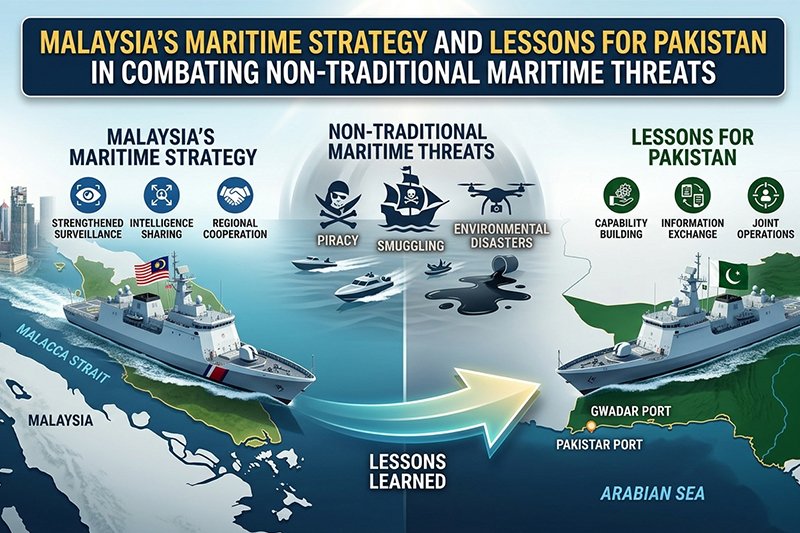
The maritime domain, specifically Indian Ocean, has great importance in international relations, because of maritime connectivity, marine resources and trading routes through sea influence economic and security relationships among countries. Besides, non-traditional maritime security (NTMS) threats like piracy, illegal fishing, marine pollution and smuggling of contraband, human trafficking and maritime terrorism have recently become a serious concern for the coastal states. Malaysia is rimming Indian Ocean in the closer proximity of Malacca Strait and has its stakes involved in the region. To address the traditional and non-traditional maritime security, Malaysia is developing a comprehensive maritime strategy that may become a platform for regional cooperation.
Malaysia’s maritime security policy is influenced by its geographic location that facilitates 80% of global trade. This route is of great strategic value, hence making Malaysia extremely vulnerable to security threats including NTMS such as oil spills, ship emissions and transnational organized crime. To counter these threats, Malaysia’s 2026 maritime strategy emphasizes technology-driven surveillance, including Artificial Intelligence (AI), Unmanned Aerial Vehicles (UAVs), and satellite-based monitoring to improve Maritime domain awareness and ensure timely response to non-traditional threats.
Furthermore, The Royal Malaysian Navy has introduced littoral combat ships, littoral mission ships, and unmanned systems, along with improved intelligence sharing through an Intelligence Fusion Center (IFC) to strengthen responses against non-state maritime threats. On the institutional level, the Malaysian Maritime Enforcement Agency is the main maritime law enforcement agency that manages the control of fisheries, anti-smuggling missions, maritime security, and response to marine pollution. One of the most significant policy actions of Malaysia in my opinion was the establishment of a centralized maritime enforcement organization since it enabled less institutional fragmentation, increased coordination between civilian and military maritime agencies, and strengthening enforcement capability in the territorial waters.
At regional level, Malaysia is pursuing a strategy of cooperative security and multilateralism in its maritime affairs, especially the ASEAN Maritime Forum and the Expanded ASEAN Maritime Forum where members and dialogue partners deliberate on maritime connectivity, marine environmental protection, piracy and illegal fishing. The importance of these platforms is that they facilitate the development of confidence-building, coordination of policies, and dialogue diplomacy to ensure that Southeast Asian states can deal with maritime disputes and security issues without escalating them to a conflict level.
Moreover the Malacca Straits Patrols and the Indonesia-Malaysia-Philippines (INDOMALPHI) trilateral patrols, which involve fighting piracy, maritime terroristic activities, smuggling and illegal fishing by directly cooperating, sharing of surveillance and intelligence are also examples of cooperative strategy to counter threats. Malaysia’s converging relations are not limited to its maritime neighbors along the strait. Rather, Malaysia is expanding its foreign policy toward Bangladesh that aspires to get a Free Trade Agreement (FTA) concluded with Malaysia by the end of 2026, streamlining shipping routes to increase the volume of petroleum and palm oil imports from Malaysia.
Following High-level visits in late 2025, Malaysia has begun advising on digital technology integration for Bangladeshi ports to improve cargo turnaround times. Additionally Malaysia remains a consistent participant in India’s biennial MILAN exercise, the largest multinational naval exercise in the Indian Ocean, and the bilateral Samudra Laksamana, which focuses on high-end surface warfare and anti-submarine drills. Therefore, Malaysia’s strategy shows that regional maritime security is not achieved through military power alone, but through institutional cooperation, information sharing and coordinated enforcement mechanisms.
The maritime relationship between Malaysia and Pakistan has expanded in 2025–2026 from limited naval ties to a more integrated partnership covering security, trade, and technology. In February 2026, Pakistan’s Chief of Naval Staff, Admiral Naveed Ashraf visited Malaysia to meet his counterpart, Admiral Tan Sri Zulhelmy bin Ithnain. They agreed to align their strategic outlooks to counter emerging threats like piracy and regional instability. In October 2025, during PM Shehbaz Sharif’s visit to Malaysia, a new agreement was reached to facilitate $200 million in Pakistani beef and meat exports under a specialized halal framework. Cooperation between the Pakistan Navy and the Royal Malaysian Navy is evident through joint participation in AMAN-2025, where both sides engaged in anti-piracy and counter-terrorism drills.
This is complemented by practical initiatives such as hydrographic data sharing for safer navigation and a marine cadet exchange program for capacity building. Economically, maritime cooperation is linked with trade (around $1.4 billion annually), with examples including Malaysia’s palm oil exports and Pakistan’s rice exports, alongside proposals for direct shipping routes between Karachi and Malaysian ports. In addition, collaboration in port digitalization through the facilitation center named as the ‘Pakistan Single Window’ highlights a shift toward modern, technology-driven maritime governance. Overall, the partnership is becoming more structured, combining security coordination with trade and digital integration.
Furthermore, Malaysia and Pakistan have significant maritime interests as they both share common coastal locations along the major Sea Lines of Communication and economic stability relies on maritime commerce and port security. The location of Malaysia on Strait of Malacca and that of Pakistan on Strait of Hormuz places both the countries in strategic positions in the sea, yet at the same time at risk of incidence of non-traditional maritime security issues such as piracy, illegal fishing, smuggling, human trafficking, and marine pollution. This similarity provides room to collaborate on maritime domain awareness, fisheries control, and marine environmental protection.
Even though Pakistan is not a member of ASEAN, it has been involved in ASEAN-led forums like the ASEAN Regional Forum and the ASEAN Maritime Forum where they offer them a chance to dialogue, learn their policies and cooperate practically. Pakistan, in my view, can draw on the experience offered by Malaysia regarding its coordinated patrol mechanisms, inter-agency maritime governance, and regional maritime diplomacy, especially in the enhancement of its maritime security system in the Indian Ocean region.
Marine environmental governance is another field that Malaysia offers valuable lessons. Shipping activities, oil spills, plastic waste, and rapid coastal development have contributed to making marine pollution a major environmental and economic issue in Southeast Asia. Malaysia has also implemented marine environmental protection policies and is an active member of regional environmental initiatives within the Association of Southeast Asian Nations especially regarding sustainable management of the marine resource and development of the Blue Economy.
Read This: Series of Foreign Policies: Liberal Internationalism & U.S Foreign Policy
In Pakistan, there is also a comparable environmental problem, particularly in the cities near the coast like Karachi in which oil spills, dumping of industrial waste, marine pollution and the extinction of fish are threatening the marine ecology as well as the coastal livelihood. Thus, a mutually beneficial environmental cooperation of Pakistan with the ASEAN countries regarding the protection of the marine area, fisheries management, and development of the Blue Economy might be the solution.
On the whole, the maritime strategy of Malaysia shows that maritime security is about combining technology, institutional coordination, and regional cooperation. The ASEAN institution structure is significant to facilitate maritime collaboration, conflict management, and regional security by means of dialogue, confidence-building, and cooperative security. Pakistan can use the experience of Malaysia which is a practical policy model to enhance institutional coordination of the Indian Ocean maritime governance, enhance regional coordination of the Indian Ocean, emphasizing marine environmental protection and sustainable fisheries as well as improving participation in the ASEAN maritime forums.
In this regard, the maritime cooperation between Southeast Asian countries and Pakistan should not be regarded as a mere act of diplomatic interaction, but as a strategic necessity in the handling of non-traditional maritime security issues in the Indian Pacific.
About Author
Ms Saba Ejaz is M,phil in International Relations. She is working as Senior Research Assistant with Dr. Maliha Zeba Khan, Principal Investigator of a collaborative research project of HEC under CPEC CRG 2022, titled “Socioeconomic Impact of CPEC On Non Traditional Maritime Security and Sustainable Development of Balochistan’s Blue Economy: Case Study of Fisheries and Seafood Industry” at the Department of International Relations, National University of Modern Languages (NUML), Islamabad, Pakistan.
Catch all the latest defense news from around the world—join us on Facebook, Twitter, YouTube, Instagram & TikTok.
Discover more from International Defence Analysis
Subscribe to get the latest posts sent to your email.