



China’s Robotic Wolf Packs: AI-Powered Units Built for Urban Warfare
China’s robotic wolf packs have officially entered the global military spotlight. On March 26, 2026, China’s state broadcaster CCTV released footage showing autonomous AI-powered combat robots operating in simulated urban warfare scenarios for the very first time. The development signals a major leap forward in autonomous battlefield technology and raises urgent questions about the future of modern conflict.
These machines do not tire. They do not fear. And they are armed.
In this article, we break down exactly what China has built, how these systems work, what role each unit plays, and what this means for the global race in military robotics.
What Are China’s Robotic Wolf Packs?
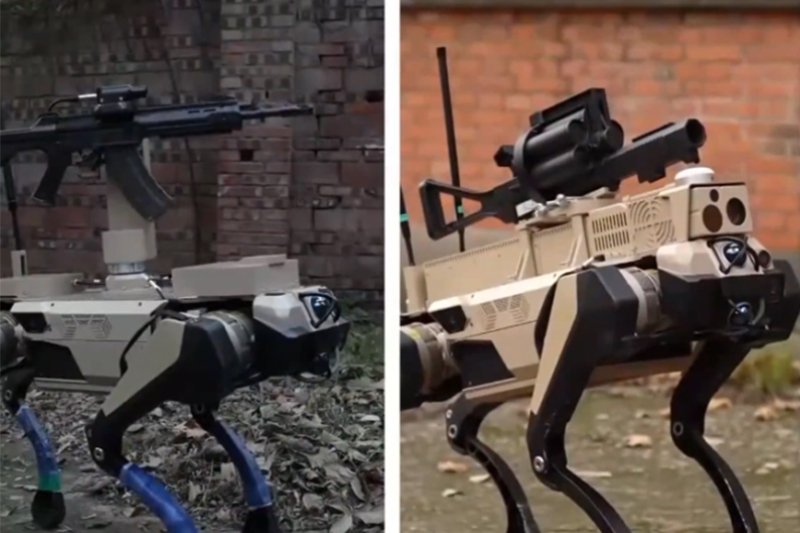
China’s robotic wolf packs are autonomous, AI-driven quadruped combat robots designed specifically for high-risk urban warfare environments. Developed by the China Ordnance Automation Research Institute Co., Ltd., these units represent the latest and most advanced generation of robotic combat systems produced by the Chinese defense sector.
Unlike earlier prototypes that were largely experimental, this new generation features significantly upgraded hardware, smarter onboard AI, and most critically the ability to coordinate and operate as a unified pack. This coordinated swarm-style approach is what distinguishes them from standalone robotic platforms.
Who Developed Them?
The systems were developed by the China Ordnance Automation Research Institute Co., Ltd., a government-linked defense research institution. The footage was first broadcast by CCTV News, China’s official state media network, indicating this is an officially sanctioned public reveal — not a leak.
| Key Fact These robots were developed for close-range, high-casualty urban combat zones — environments where sending human soldiers creates maximum risk to personnel. |
Weapons and Combat Capabilities
The combat capabilities of China’s robotic wolf packs go far beyond surveillance or logistics. These units are built to fight. Each robot can be equipped with a loadout of advanced weapons systems designed for urban warfare scenarios:
- Micro missiles — precision strike capability at close to medium range
- Grenade launchers — for area suppression and clearing fortified positions
- AI-driven targeting — autonomous identification and engagement of targets
Their design focus is on dense, complex environments: city streets, narrow corridors, multi-story buildings. These are exactly the kinds of terrain where human infantry casualties are historically highest, and where conventional armored vehicles cannot operate effectively.
The combination of firepower and autonomous coordination makes China’s robotic wolf packs capable of conducting offensive combat operations with minimal direct human intervention. Operators guide overall strategy but the machines handle real-time execution.
Meet the Pack: Shadow, Bloodstained and Polar Units
One of the most sophisticated aspects of China’s robotic wolf pack system is its role-based structure. Rather than deploying identical units, the pack is composed of three specialized types — each designed for a distinct battlefield function. This mirrors the organizational logic of elite human military squads.
Shadow Units — Reconnaissance and Scouting
Shadow units operate as the eyes and ears of the pack. Their primary role is reconnaissance — moving ahead of the main force to gather intelligence, map terrain, locate enemy positions, and identify threats before the pack engages. They prioritize stealth and situational awareness over firepower.
Bloodstained Units — Direct Attack
Bloodstained units are the offensive core. Armed with the pack’s primary weapons systems including micro missiles and grenade launchers these robots lead direct assault operations. Their AI systems are optimized for target acquisition, threat prioritization, and coordinated fire suppression.
Polar Units — Operational Support
Polar units maintain the operational integrity of the pack. Their role includes logistical support, communications relay, battlefield coordination, and sustained mission capability. Think of them as the command-and-control backbone that keeps Shadow and Bloodstained units operating at peak efficiency.
| Why This Matters Role specialization allows these machines to function like a real military team — not just a collection of individual robots. It dramatically increases their effectiveness in complex, dynamic combat scenarios. |
How Operators Control the Robots
Despite their high level of autonomy, human operators retain overall command authority over the robotic wolf packs. The control systems are designed for intuitive real-time interaction on the battlefield:
- Voice commands — operators issue high-level directives verbally
- Data gloves — gesture-based control for fine-grained real-time direction
- AI coordination layer — the pack interprets and executes commands autonomously within defined parameters
This human-machine coordination model keeps a human in the loop for strategic decisions while delegating tactical execution to the AI. It is a design philosophy increasingly common in advanced military robotics sometimes called “human-on-the-loop” rather than “human-in-the-loop.”
China vs USA: The Global Military Robotics Race
China’s reveal of its robotic wolf packs is not happening in a vacuum. It is the latest move in an intensifying global competition to field autonomous military systems and the United States is the primary rival.
The U.S. military has made significant investments in robotic platforms. Boston Dynamics’ Spot robot a quadruped that has become the most recognizable “robot dog” in the world has been tested by multiple branches of the U.S. armed forces for surveillance, inspection, and logistics support. DARPA has funded numerous autonomous ground vehicle and drone programs. The U.S. Air Force and Army are actively exploring armed unmanned systems at scale.
However, the United States has generally taken a more cautious and deliberate approach toward deploying fully autonomous lethal systems. Ethical debates, legal frameworks around the laws of war, and public scrutiny have slowed the path from prototype to battlefield deployment. The U.S. military doctrine still emphasizes meaningful human control over lethal force decisions.
China appears to be moving with fewer such constraints and the public release of this footage suggests Beijing is comfortable signaling that fact to the world.
Also Read: Turkish Defense Industry Uses AI to Upgrade Missile Systems
Beyond the U.S., other nations are accelerating similar programs. South Korea has deployed armed sentry robots along the DMZ. Turkiye’s Kargu-2 loitering munition has already seen battlefield use. Israel leads in autonomous drone and aerial systems. Russia continues to invest in unmanned ground vehicles. The convergence of AI, robotics, and weapons technology is happening simultaneously across multiple military powers.
What This Means for the Future of Warfare
The deployment of China’s robotic wolf packs raises questions that go far beyond hardware specifications and range statistics. At its core, this development forces a reckoning with a profound question: what happens when the cost of war in human lives is removed from one side of the equation?
When autonomous machines absorb the risk of urban combat, the political and strategic calculus shifts. Governments may find it easier to initiate or escalate conflicts when their own soldiers are not in harm’s way. The human cost that historically acts as a brake on military action public grief, casualty figures, the weight of loss is reduced or eliminated entirely for the side deploying autonomous systems.
There is also the critical issue of accountability. International humanitarian law requires that combatants distinguish between military targets and civilians, and that attacks remain proportionate. When an AI system makes a targeting decision that results in civilian casualties, who bears legal and moral responsibility? The developer? The commanding officer? The government that deployed the system? These questions remain unresolved in international law.
Finally, there is the arms race dynamic itself. Each nation that deploys increasingly capable autonomous weapons creates pressure on rivals to do the same and faster. History suggests that arms races rarely end in stability.
Conclusion
China’s robotic wolf packs represent a genuine inflection point in military technology. For the first time, the world has seen combat-ready autonomous robots armed, coordinated, and role-specialized operating in realistic urban warfare simulations. The footage released by CCTV on March 26, 2026 is not just a product demonstration. It is a strategic signal.
Whether this development accelerates global arms control efforts around autonomous weapons, or simply accelerates the race to field similar systems, remains to be seen. What is certain is that the battlefield of the future will look profoundly different from anything that came before and the decisions made in the next few years will shape the character of conflict for decades to come.
Stay informed. The race is already underway.
Catch all the latest defense news from around the world—join us on Facebook, Twitter, YouTube, Instagram & TikTok.
Discover more from International Defence Analysis
Subscribe to get the latest posts sent to your email.